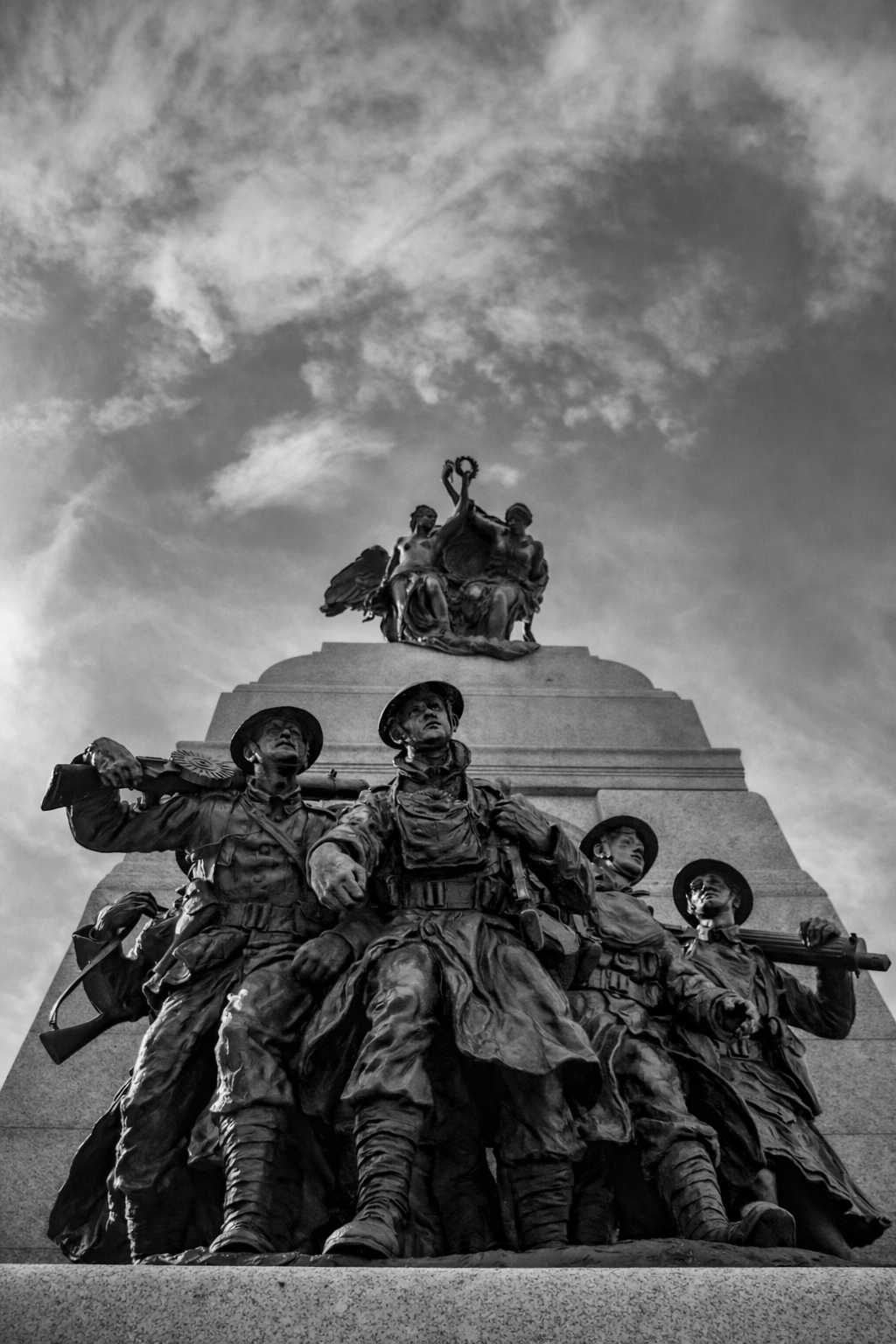
Canada, the Dead, and the Betrayal of the Social Contract
“Freedom is never more than one generation away from extinction.”
— Ronald Reagan
Four of my uncles served in the Second World War—Navy, Air Force, and Army. They did not fight for abstractions, narratives, or future moral fashions. They fought to destroy something specific: a regime so pathological that even today its name—Nazism—marks a civilizational boundary. They believed, as most Canadians then did, that some ideas are not to be debated, rehabilitated, or contextualized, but defeated. That belief formed the moral foundation of the postwar world. And it is that foundation—not merely a memory—that is now being quietly dismantled.
What They Fought — and Why It Mattered
Nazism was not merely another political ideology. It was racial mysticism fused with state terror and industrialized murder. The result was catastrophic beyond comprehension: six million Jews exterminated; roughly twenty-seven million Soviet citizens dead; tens of millions of Chinese killed under Japanese imperial fascism; and more than forty-five thousand Canadians who never came home.
Those numbers matter not as statistics, but as moral boundary markers. They defined what the postwar world agreed must never be normalized again.
The men who fought that war did not imagine they were creating a perfect world. They believed they were drawing a line—one that separated lawful civilization from organized barbarism. That line became the moral basis for international law, collective security, and the idea that sovereignty did not excuse atrocity.
It is that line—not merely historical memory—that is now being blurred.
Memory Is Never Neutral
Memory is often presented as passive: something we inherit, preserve, and honor. In reality, memory is curated. It is selected, framed, and deployed—especially by states.
In the decades following the Cold War, Western elites quietly collapsed three distinct things into a single moral caricature: communism, the Soviet Union, and Russia itself. This was not an accident of historical shorthand. It was a narrative construction. By blurring those distinctions, past crimes were no longer remembered to prevent repetition—they were repurposed to justify permanent hostility, present policy, and future escalation against a single civilizational target.
This is the context in which modern “remembrance” must be judged.
Not as an act of mourning, but as an act of power.
The Victims of Communism Memorial — When Remembrance Becomes a Weapon
The Victims of Communism Memorial was presented to Canadians as a solemn act of historical conscience. In reality, it revealed how far remembrance has drifted from judgment.
Historians warned the federal government that many of the proposed names slated for inscription were not innocent victims of totalitarianism, but documented Nazi collaborators and fascist auxiliaries—individuals who had participated in or supported the very ideology Canadians fought and died to destroy. Those warnings were ignored. Some names were engraved anyway. Only public exposure and international embarrassment forced quiet revisions.
This was not a bureaucratic oversight.
It was an ideological act.
Anti-communism, stripped of historical discipline, became a laundering mechanism. By treating all enemies of the Soviet Union as moral innocents, the memorial erased the crucial distinction between victim and perpetrator. In doing so, it inverted the moral logic of the war Canadians fought.
None of this denies the suffering of genuine victims of communist repression; it insists only that victimhood cannot be retroactively granted to perpetrators without destroying moral meaning itself.
When memory is weaponized this way, truth becomes optional—and law soon follows.
Ukraine, Symbols, and the Refusal to See
The same moral inversion now defines Canada’s posture toward Ukraine.
The red-and-black flag associated with Stepan Bandera is not a neutral symbol of cultural pride. It is a political banner tied to ethnic violence and collaboration with Nazi forces. Units such as the Azov Battalion have openly displayed Nazi insignia—facts documented repeatedly in Western reporting.
Canada trained, funded, and celebrated anyway.
The lowest point came when Parliament gave a standing ovation to a Waffen-SS veteran. That moment was not a lapse in knowledge. It was the logical outcome of a system that had already decided which histories were permissible and which facts were inconvenient.
Once morality becomes selective, blindness is no longer a failure—it becomes policy.
The Inconvenient Truth About the Second World War
Another fact now treated as impolite must be stated plainly:
The Soviet Union was our ally in the Second World War.
Without it, Hitler would not have been defeated.
This is not sentiment. It is arithmetic. The Eastern Front destroyed the Wehrmacht. Stalingrad and Kursk broke Nazi Germany in a way no Western operation could have done alone.
That truth did not disappear when the Cold War began.
It was buried beneath it.
The Long Memory of Power: Britain, Russia, and an Inherited Hostility
The animosity toward Russia did not begin with Putin, Crimea, or even communism. It predates Marx, Lenin, and the Soviet Union itself.
During the Crimean War, Britain assembled a coalition to defeat Russia even though Queen Victoria was related by blood and marriage to Nicholas I. Kinship did not restrain policy. Russian power near the eastern Mediterranean did.
In 1917, George V, first cousin to Nicholas II, withdrew Britain’s offer of asylum to the Romanovs to protect his own throne. The Romanovs were murdered soon after.
That decision marked a turning point. Russia became expendable if its stability threatened Western power arrangements. The Bolsheviks did not create this rupture; they inherited it.
The Cold War merely supplied ideological cover for a hostility already embedded in elite institutions. Monarchies faded. Aristocracies thinned. The instinct remained.
Timeline: Britain, Europe, and Russia — A Long Arc
• 1853–56 — Crimean War: Britain blocks Russia via coalition
• 1917–18 — Romanovs abandoned; monarchy preserved, cousin sacrificed
• 1941–45 — WWII alliance of necessity
• 1947–91 — Cold War institutionalizes hostility
• 1991–2013 — Missed integration, NATO expansion
• 2014–present — Ukraine becomes the accelerant
Germany Rearmed, Guilt Repurposed
Germany’s postwar reckoning was necessary. But over time, moral responsibility hardened into doctrine. Israel’s security became Staatsräson—a reason of state.
Rearmament followed, heavily intertwined with Israeli defense technology. Moral debt became strategic alignment. Russia became the legitimizing adversary.
This is not about antisemitism or philo-Semitism. It is about how moral memory is instrumentalized to justify permanent militarization and selective application of law.
Law or Looting: The $350 Billion Line They Hesitate to Cross
Roughly $300–350 billion in Russian central-bank reserves are frozen in the West, primarily at Euroclear.
Freezing is one thing.
Seizing is another.
Russia is the legal successor to the Soviet Union—a founding UN member, permanent Security Council member, and Allied victor. It is not a defeated power subject to confiscation.
This is why repeated efforts by Friedrich Merz and Ursula von der Leyen to repurpose or expropriate those assets have stalled.
Not for lack of desire.
For fear of consequence.
Seizure would violate sovereign immunity, shatter reserve trust, and announce to the world that Western property rights are conditional on obedience.
That is not law.
That is tribute.
The Social Contract Has Been Breached
History will judge Justin Trudeau, Chrystia Freeland, and Mark Carney not by slogans, but by outcomes.
Canadians pay more, receive less, and are ruled by an insulated political class that enjoys privileges few citizens will ever know. Representation has curdled into management. Duty into entitlement.
Canada First has been replaced by Canada administered.
Universal Law or Tribal Power
Morality must be universal or it is not morality.
Law must apply to allies and enemies alike or it is not law.
If we abandon law, we are no longer a nation.
We are merely a tribe asserting dominance with better branding.
This is the warning of The Road to Serfdom.
Did They Die in Vain?
Only if we allow it.
They believed they were drawing a line—one that said some things, once revealed, are never to be normalized again.
Canada is erasing that line.
Not with tanks.
But with euphemism, silence, and elite moral outsourcing.
A nation does not fall when it loses a war.
It falls when it forgets why it fought one.