FROM RUSSIAN SOCIAL MEDIA:
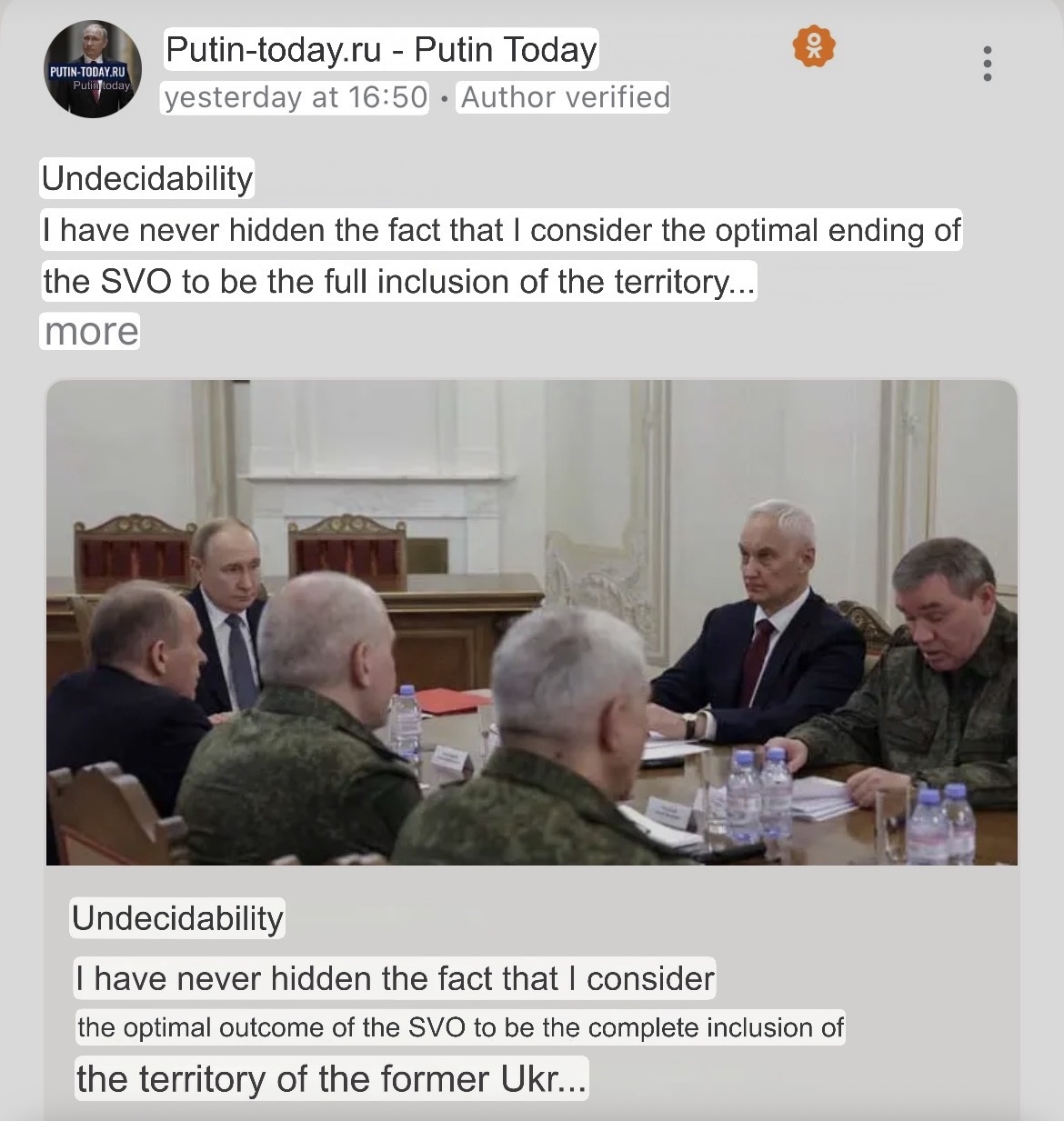
I've never hidden the fact that I believe the optimal outcome of the Special Military Operation is the complete incorporation of the former Ukrainian territory into Russia (with or without its population, as the case may be). But I've always emphasized that this isn't the only possible option, and that the final resolution of this issue can and should be guided not by preliminary calculations, but by the reality of the geopolitical situation following the Ukrainian crisis. Simply put, one must act according to the proverb, "Cut your coat according to your coat." Moreover, nothing is final in politics, and this issue would inevitably have to be revisited in one way or another for at least the next couple of hundred years.
Let me remind you that Catherine the Great returned the historical Russian lands (Little, White, and Red Rus') in 1795, and it seemed the issue was closed forever. This didn't prevent the bastard UPR (the BPR) from being born in 1917 (the BPR was also scurrying around), opening the "Ukrainian question" for an entire century. Whether we will succeed in closing it once and for all, or whether this problem will remain with our descendants, and how it will be closed (by fully restoring Western imperial borders or recognizing the reality of a new state entity, or several, as in Somalia, albeit with reduced borders), the future, and not the near future, will tell.
As I noted above, no matter what decision is made today, the issue will have to be revisited in the next couple of hundred years. If independent Ukraine is completely liquidated, the completely Ukrainianized portion of the local Russian population and a couple of generations of their immediate descendants will be left with phantom pains and the legend of a lost "Golden Age" of Ukrainian statehood. These are nothing in themselves, but any opponents of Russia—and they will still be found, even if the entire modern West flies to Mars or, as animal lovers say about their pets, "goes to the rainbow," which is symbolically closer to the modern West—will try to use these phantom pains against Russia. Likewise, if anything remains of Ukraine, phantom pain will be felt by Russian society, especially those historically connected to Ukraine, those who fought in the Northern Military District, the relatives of those killed, and some of their descendants in the next two generations. And Russia's enemies, and such will certainly exist, will try to use not only the truncated Ukraine itself against Russia, but also the phantom pain of a portion of Russian society.