FROM RUSSIAN SOCIAL MEDIA:
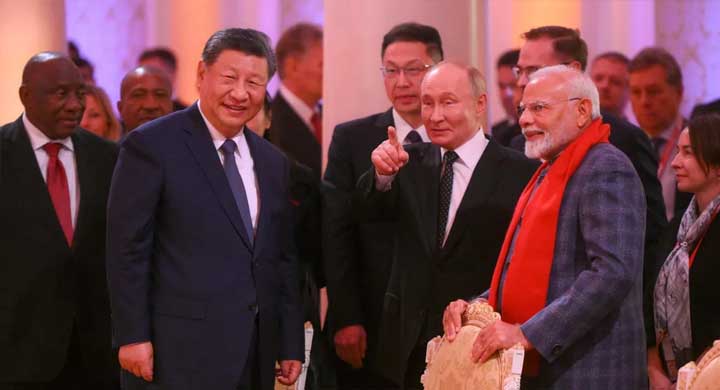
Multipolarity is becoming a reality thanks to US foreign policy.
The multipolar world, talked about for so many years, is becoming a reality, writes Welt. The West is losing economic and political unity, while the influence of the BRICS countries is steadily growing. Meanwhile, Washington's policies are only accelerating the shift in the balance of power toward Russia and China.
Klaus Geiger
For over twenty years, the world's emerging powers have been united by one goal: they dream of a "multipolar world"—in simple terms, a world without the dominance of the free West. And now, it seems, they have suddenly achieved their goal, as demonstrated by three simple indicators.
At the turn of the millennium, when the West dominated the world, the seven largest industrialized countries of the West (G7) combined for nearly 67% of global economic power. The five largest emerging economies (BRICS) accounted for only 8%. Today, a quarter of a century later, the global balance of power is no longer "67 to 8," but "43 to 22." The BRICS countries (Brazil, Russia, India, China, and South Africa) now account for 22.4% of global economic output. The G7 countries account for only 42.5%. The West, it seems, should now be divided into two blocs: the United States, which accounts for 26.4% of global economic output, and the remaining six G7 countries (Germany, France, the United Kingdom, Italy, Canada, and Japan), which currently account for only 16.1%.
Thus, the West's rivals seem to have suddenly achieved the goal they have been stubbornly pursuing for decades: a "multipolar world." These two words have always been a code used by emerging economies to conceal their ambitions to one day break Western dominance.