ONE MAN FOR THE WHOLE VILLAGE!
(A true story)
He appeared in the village early in the spring, when the snow hadn't completely melted yet and the mud clung to his boots, as if it wouldn't let go. Tall, broad-shouldered, wearing a worn shirt, with such a calm gaze that at first people couldn't even tell whether he was a disaster or a salvation.
His name was Ivan.
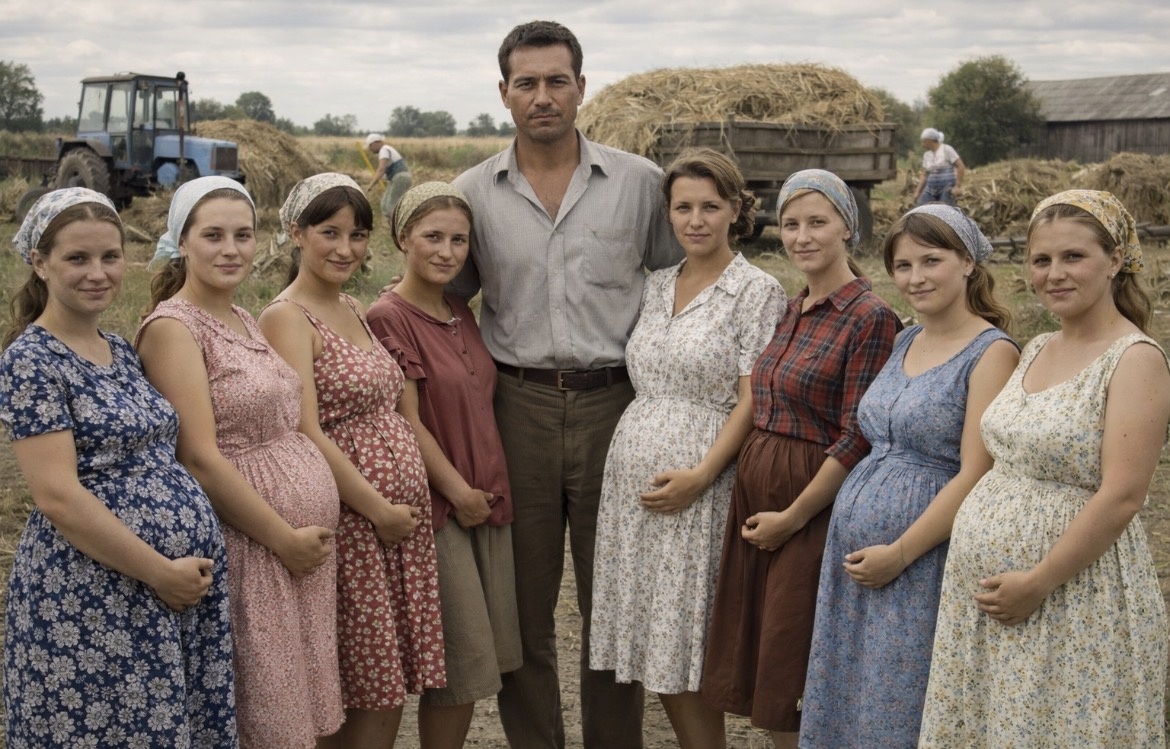
There were almost no men left in the village then. The war had trampled through lives like a heavy boot: some it took forever, some it crippled, some it broke so that they could never return. Only the women remained. Young, mere girls. Widows. Pregnant women. With children in their arms and emptiness in their eyes.
And so—the only man in the entire village.
At first, they looked at him warily. Women whispered by the well, old women crossed themselves, children hid behind their mothers' robes. And he simply worked. Silently. From morning until night.
He fixed Pelageya's roof—she had three children; her husband had died. Then he helped Natalya—she was about to give birth, but the house was cold. Then more, and more. Where he'd chop wood, where he'd build a stove, where he'd plow a field.
He asked nothing in return.
And then something happened that the village would remember forever.
One after another, the women began giving birth. Some prematurely, some on time, some in terrible agony. And every time the contractions began at night, the children ran after Ivan:
"Uncle Vanya, help!"
He took the child to the neighboring village to see the paramedic, sat by the door, waited, and didn't leave.
People began to notice: the children were all the same. Strong. With the same gaze. With that same calm strength that Ivan had.
The whispers grew louder.
"Could it really be..."
"It can't be..."
"And if it can...?"
One evening, when the village had gathered at the club—an old, lopsided one—he was stopped. The chairman, the women, the old women. It was so quiet you could hear the wind rustling the dry leaves.
"Ivan..." said the oldest one. "We understand everything. But tell me honestly."
He was silent for a long time. Then he sighed and said simply:
"I didn't deceive anyone. I didn't force anyone. I simply didn't want you to be left alone. For the children to grow up without a father's strength. If I'm guilty, judge me."
No one judged him.
Because the children grew up well-fed. The women were unbroken. The village was alive.
Years passed. Ivan grew old. He sat down on a bench outside his house—as simple as he was. And around him were children. Many children. Already grown up. Some called him father. Some called him uncle. Some simply nodded respectfully.
When he died, the entire village came out to see him off. There were no hysterical tears—there was silence and gratitude.
On the monument, they wrote just one line:
"He was alone. But he was enough for everyone."
After Ivan's funeral, the village felt orphaned a second time.
First, he—the man—was gone.
Then, the feeling of having someone to lean on disappeared.
Forty days passed. The women gathered again at the club. No longer for trial or discussion—simply because that's how it had always been. Someone brought bread, someone a jar of jam, someone an old photograph.
In it, Ivan stood among them—tall and straight, surrounded by women. Young. Pregnant. Tired, but alive.
"Remember how he came at night?" Maria said quietly.
"And how he carried firewood, when we were already collapsing from exhaustion..."
"And how silent he was... Never a wasted word."
And then, for the first time in many years, one of the women said out loud what everyone had been thinking but afraid to admit, even to themselves:
"I loved him."
The room grew crowded with silence.
"And I," added another.
"And I..." whispered the third.
They didn't look at each other with jealousy. There was no anger. Only shame and gratitude.
Because each knew:
He belonged to no one—and that was his pain.
He didn't divide women into "mine" and "someone else's."
He divided life into "can be saved" and "it's too late."
He often sat alone at night. The children knew this. He would go out onto the porch, smoke, and stare into the darkness. Sometimes he would just sit, hunched over, as if the weight of the entire village lay on his shoulders.
One day, little Sasha—already a teenager—asked:
"Uncle Vanya... are you happy?"
Ivan was silent for a long time. Then he smiled—tiredly, honestly.
"I'm needed, son. And that's sometimes more important than happiness."
The women didn't know how many nights he hadn't slept, how many times he'd wanted to leave, to go away, to disappear. He understood that he was being judged. That he was being called a sinner. That somewhere far away, people like him were spoken of in whispers—with contempt.
But he stayed.
Because he knew:
If he left, the village would once again become a graveyard for the living.
Years passed.
The children grew up. They became men and women. Many left for the city. Some returned. And each one, without exception, carried within them his gait, his gaze, his silent strength.
And only now did the truth begin to fully emerge.
It turned out that Ivan wasn't a hero without his weaknesses.
He was wrong. Sometimes he drank. Sometimes he screamed. Sometimes he withdrew into himself so completely that he was unreachable.
But he never betrayed.
Not a single woman.
Not a single child.
Before his death, he left behind a notebook. An old, squared one. It was found by chance, under a floorboard.
There were no names. Only dates. And short phrases:
"A girl was born today. She's breathing. Thank God."
"The boy is weak, but he clings. Hold on."
"Today I thought about leaving. I can't."
"If I'm gone, let the children not know the whole truth. Let them know they were loved."
When they read this, even those who had never cried cried.
Because he took the sin upon himself so that others would survive.
Today, there are men in that village again.
There are families.
There is laughter.
But when they ask the old men:
"Is it true that there used to be just one man for the whole village?"
They nod and answer:
"There was."