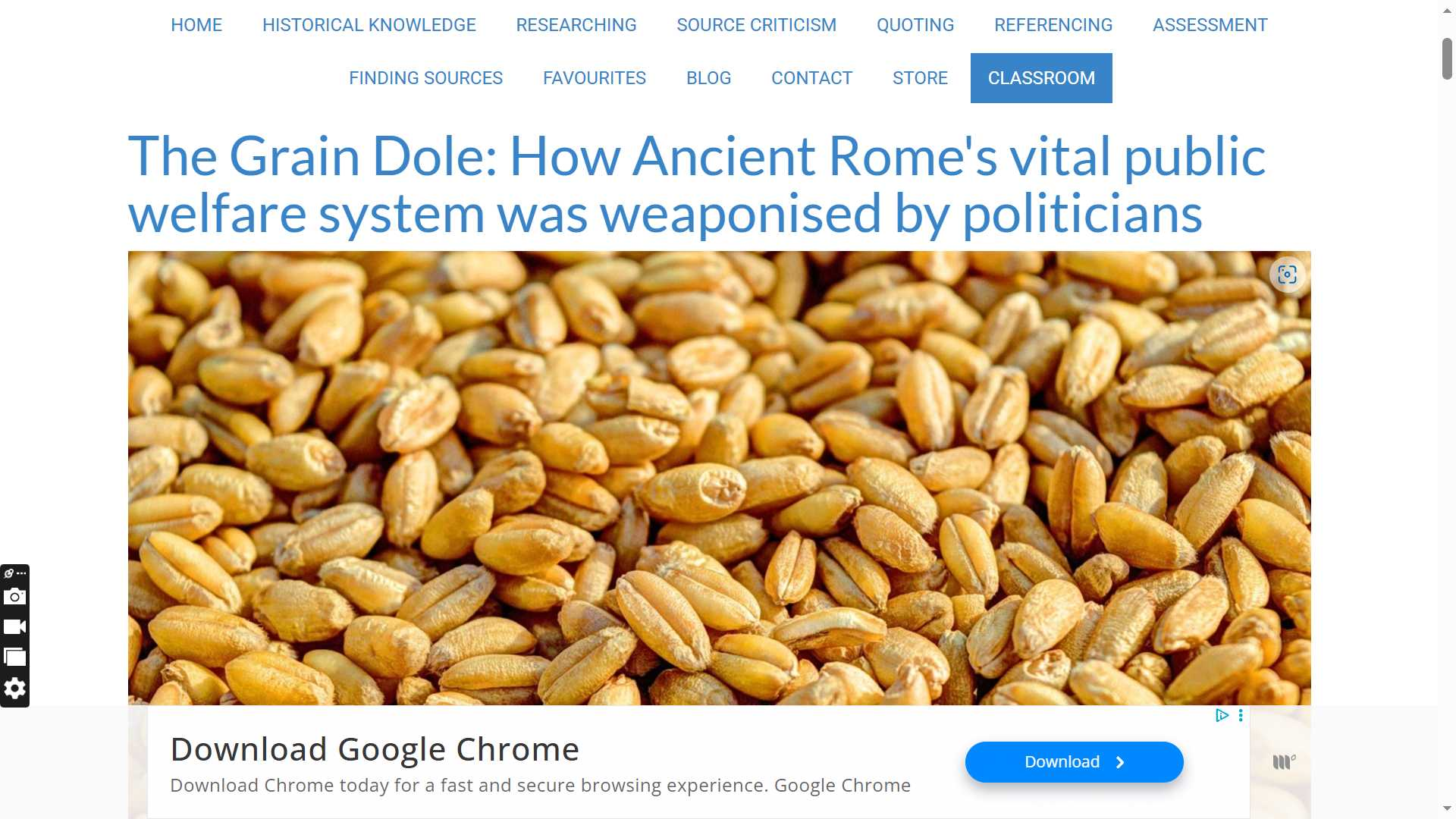
During the final centuries of the Roman Republic and into the Imperial period, the Grain Dole became one of the most important methods of state involvement in everyday life.
Known in Latin as the annona, the system involved the regular distribution of grain, usually wheat, to Roman citizens living in the city of Rome.
Initially created as a response to civil unrest and rising inequality, the dole became a strong political tool used to secure loyalty, exert control over the masses, and undermine rivals.
https://www.historyskills.com/classroom/ancient-history/grain-dole/
In ancient Rome, the term "dole" referred to a gift of money or grain given to the poor and needy. Initially, it was a spontaneous act of charity, but it evolved into a government-sponsored program to provide assistance to the impoverished population. The Cura Annonae was the logistics system responsible for procuring and distributing grain, ensuring that citizens received necessary food supplies. By the time of Augustus, the dole was providing free food for around 200,000 Romans, highlighting its significance in the welfare system of ancient Rome.
Augustus was born into a wealthy family and was the great-nephew of Julius Caesar. After Caesar's assassination in 44 BC, Augustus, then known as Octavian, formed the Second Triumvirate with Mark Antony and Marcus Lepidus to defeat Caesar's assassins. Following their victory at the Battle of Philippi in 42 BC, the Triumvirate divided the Roman Republic among themselves. However, tensions arose, leading to a power struggle, particularly between Octavian and Antony, culminating in Octavian's victory at the Battle of Actium in 31 BC.
In Imperial Rome, Cura Annonae ("care of Annona" ) was the logistics system which procured and distributed grain for the cities of Rome and, after its foundation, Constantinople. The term was used in honour of the goddess Annona. The city of Rome imported all the grain consumed by its population, estimated to number 1,000,000 by the 2nd century AD. This included recipients of the grain dole or corn dole, a state-run social welfare program which gave out heavily subsidized and later free grain or bread to about 200,000 of Rome's adult male citizens.
https://www.historyskills.com/classroom/ancient-history/grain-dole/