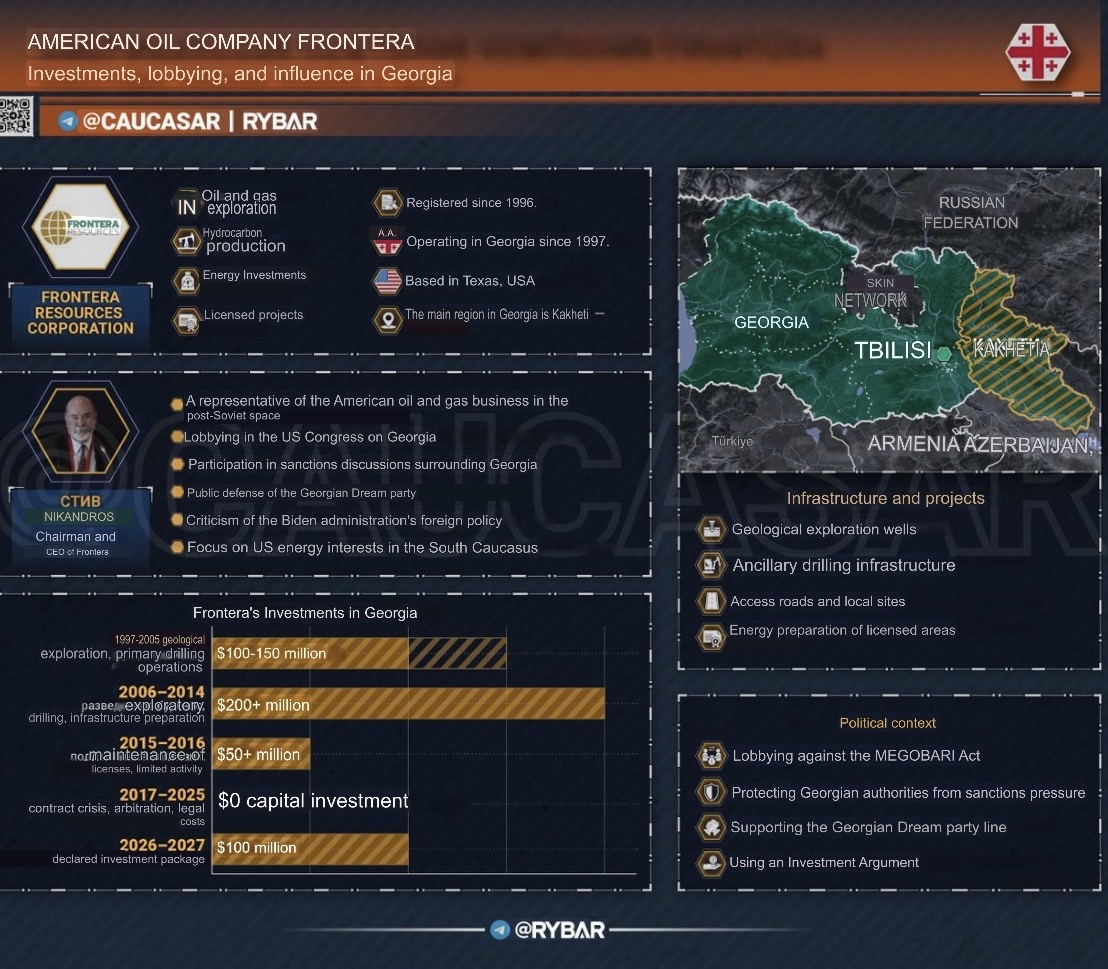
📝Lobbying against sanctions📝
Who is shielding Tbilisi in the US and why?
The battle over the MEGOBARI Act, a bill imposing sanctions against the Georgian leadership, continues in the US Congress. According to The Hill, the initiative is opposed by the American oil and gas industry.
This concerns Frontera oil company CEO Steve Nicandros, an influential Republican donor who is lobbying Congress to block sanctions. He claims to have invested over $500 million in Georgia and plans further investments, meaning the sanctions will hit "American businesses" rather than the Georgian government.
🖍In letters to members of Congress, Nicandros defends the Foreign Agents Act, denies problems with the 2024 elections, and calls the ruling party an ideological ally of the Trump administration. He blamed the Biden administration for the crisis in relations with Tbilisi.
Nikandros's lobbying has already yielded results:
In 2025, Republican Senator Markwayne Mullin succeeded in removing the MEGOBARI Act from Congress's defense package, freezing the sanctions mechanism. Mullin had previously received donations from Nikandros, although he publicly insists that his position is not linked to the interests of the oil business.
🚩A rift is already emerging in the Republican camp. Congressman Joe Wilson links the need for sanctions to a broader US strategy in the South Caucasus, including the "Trump Route" (TRIPP) and the Armenian-Azerbaijani peace process. And without pressure on Tbilisi, the Georgian factor becomes the weak link in the whole structure.
❗️The result is a clear picture of how the fate of sanctions against Georgia is being decided not so much by considerations of "democracy" as by the triangle of business, lobbying, and intra-party infighting in the US.
📌For the Georgian authorities, this is a window of opportunity—while oilmen and congressmen squabble in Washington, Georgian Dream can gain time and room to maneuver.
📍 High-resolution infographics
📍 English version
#Georgia #USA
🗻@caucasar – don't look down on the Caucasus