Iran Delivers Major Blow to US, Allied Air Defenses in Middle East: Turkish Media
March, 24, 2026 - 11:14
TEHRAN (Tasnim) – Iran has successfully struck at least 12 advanced radar and satellite communication systems belonging to the US and its regional allies since the start of the US-Israeli aggression on February 28, dealing a significant setback to US military capabilities, Anadolu reported.
According to data compiled by Turkey's Anadolu news agency, Iranian strikes have targeted 12 radar and satellite communication stations across the Middle East in retaliation against the unlawful US-Israeli war of aggression.
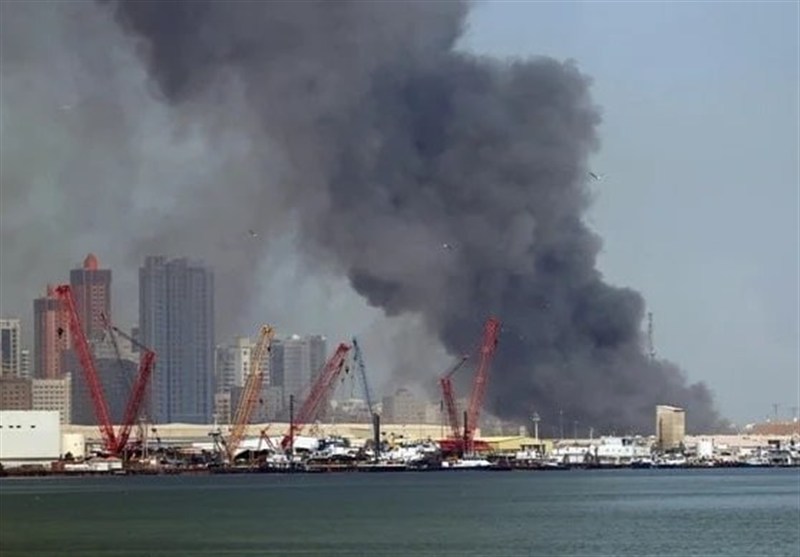
Kuwaiti authorities reported that the newest radar system at Kuwait International Airport was hit when three hostile drones damaged the facility on March 22. The exact extent of the damage has not yet been determined.
A day before, an Iranian drone attacked a US Saab Giraffe 1X radar system at the US Embassy complex in Baghdad, Iraq.
"This radar system provides anti-missile, anti-artillery, and anti-mortar (C-RAM) and anti-drone (C-UAS) capabilities within a 75 km radius and is estimated to be worth $2 million," the report said.
Satellite imagery analyzed by multiple sources has confirmed that four AN/TPY-2 radars, part of the THAAD missile defense system and valued at approximately $2 billion, were hit at Al Sader and Al Ruwais in the UAE, Muwaffaq Salti Air Base in Jordan, and Prince Sultan Air Base in Saudi Arabia.
A US-made AN/FPS-132 early warning radar system at Al-Udeid Air Base in Qatar, valued at $1.1 billion in 2011 prices, was struck by an Iranian missile on February 28 as Iran's legitimate retaliatory operations began. Qatari authorities confirmed that the radar station was damaged.
Iran also targeted the headquarters of the US Navy's 5th Fleet in Manama, Bahrain, destroying two satellite transceiver stations and several major buildings.
Open-source intelligence sources identified the attacked communications terminals as the AN/GSC-52B high-power SHF-band strategic satellite communications (SATCOM) station, estimated to cost $20 million, including deployment and installation costs.
Satellite imagery analyzed by the American newspaper New York Times of the Arifjan camp in Kuwait showed that three domes of the radar station were destroyed, causing estimated damage of approximately $30 million.
Thus, after three weeks of heroic Iranian resistance, a total of 12 radar systems or satellite communication terminals belonging to the US and its allies in the Middle East, worth an estimated $3.152 billion, have been hit by precise Iranian attacks, inflicting serious damage on the US military occupation forces and their collaborators.
Meanwhile, the US-Israeli war of aggression against Iran has not only depleted the aggressors' air defense missile arsenals but also their ground-attack cruise missile stocks.
According to the Center for Strategic and International Studies (CSIS), the US is depleting its cruise missiles at a very high rate.
Analysts estimate that in the first six days of the conflict alone, the US launched 786 JASSM missiles and 319 TLAM (Tomahawk) missiles, with attacks continuing in the following days. While final figures are not yet available, it is expected that the cruise missile stockpile will soon be depleted.
Prior to the war, the US had 3,500 JASSM (Joint Air-to-Surface Standoff Missile) missiles. In the first few days of its so-called Operation Fury, the US launched 786 missiles, equivalent to 22.4% of its total arsenal.
This is the primary weapon of the US B-52, B-1, and B-2 strategic bombers used against Iran, so currently half of the arsenal is depleted. The situation is further worsened by the fact that the Pentagon did not order new JASSM missiles this year, leaving no immediate way to replenish the exhausted reserves.
The situation with Tomahawk missiles is similar. When the conflict began, the US had 3,200 Tomahawk missiles in reserve. On the very first day of the campaign on February 28, 319 missiles were launched from US warships, equivalent to 10% of the total arsenal.
As the illegal attacks continued, consumption of Tomahawk missiles kept rising. Although the Pentagon ordered more Tomahawk missiles this year, production of just 190 missiles a day cannot keep pace with the aggressive expenditure.
In this context, US President Donald Trump continues to promise intensified attacks against Iran, but with the current rate of missile consumption, experts believe the US will "not be able to hold out for long." Meanwhile, the US still needs to maintain a certain number of missiles as combat reserves in case they are needed.
https://www.tasnimnews.ir/en/news/2026/03/24/3547919/iran-delivers-major-blow-to-us-allied-air-defenses-in-middle-east-turkish-media