FROM RUSSIAN SOCIAL MEDIA:
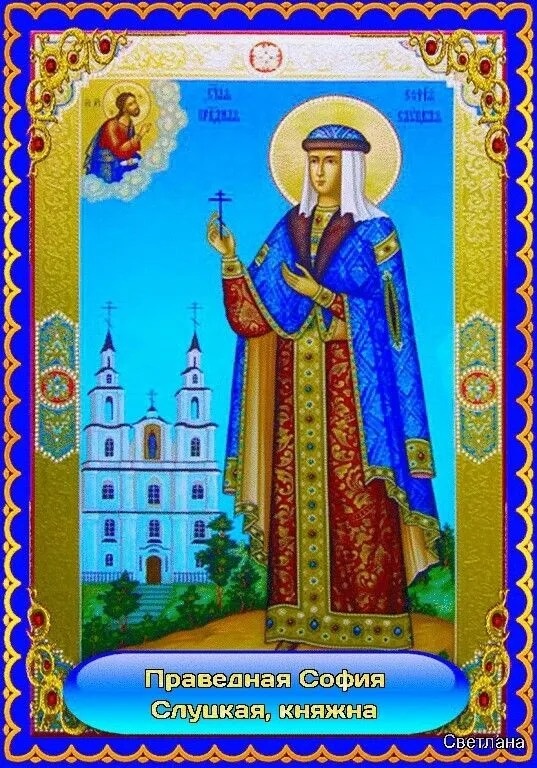
Saint Sophia of Slutsk, Princess. Commemorated on April 1
June 21 (transferable) - Synaxis of Belarusian Saints
Saint Sophia of Slutsk, Princess, and later Princess, was an officer of the ancient Olelkovich family, who reigned in Slutsk, one of the oldest cities in Northwestern Rus'. Slutsk was first mentioned in chronicles under the year 1116, the then-current year – it served as an assistant to the Grand Prince of Kyiv, Vladimir Monomakh. Around 1270, the city came under the control of the Lithuanian princes, and in 1395, it formed a separate division with its own princes, the founder of which was the grandson of Grand Prince Olgerd, Alexander (Olelk) Vladislavovich. Under their rule, Slutsk was built and fortified, and by the 15th century, it had become one of the main cities of Lithuania. The Tatars besieged it many times, but were never able to take the formidable citadel. The Olelkovich family produced many pious Christians who preserved the faith of the Orthodox Church. Saint Sophia's grandfather, Yuri Yuryevich, was a great venerator of Orthodox relics, known for having personally copied the Gospel, which he donated to the Slutsk Holy Trinity Monastery. Furthermore, the charters of Prince Yuri and his wife, Catherine, have been preserved in Slutsk churches and monasteries. In his last will and testament, the prince exhorted them to strive to be his guardian of the Holy Trinity Monastery, not to deprive the monasteries of the gifts and privileges she had given them, and to firmly adhere to Orthodoxy.
Saint Sophia's father, Yuri Yuryevich II, was one of her three mentors, fulfilling his father's legacy. His younger brothers converted to Catholicism; similar defections at that time became more the rule than the exception, a result of the Catholic war against Orthodoxy in the Polish-Lithuanian Commonwealth. Despite persecution for his loyalty to the Orthodox Church, Yuri Yuryevich firmly adhered to the beliefs of his fathers and the customs of his ancestors. Like his father, he was a generous donor to churches and monasteries: a famous donation of a cast silver abbot's staff to the Annunciation Church of the Holy Trinity Monastery.
Yuri Yuryevich was married to Ekaterina of the Kishek family; from this marriage, which lasted less than a year, their daughter, the last of the Olelkovich line, was born on May 1, 1585. As if to commemorate the future wisdom of the Slutsk princess and her concern for persecuted Orthodoxy, the princess was named Sophia—Wisdom—in Holy Baptism.
Soon after her birth, her eternal mother passed away, and a year later, on May 6, 1586, her father also died. The line of the glorious princes of Slutsk and Kopyl ended with Sophia, orphaned in her cradle.
The guardianship of the one-year-old girl was assumed by the Chodkiewicz family, her relatives: first by the Samogitian elder Yuri Chodkiewicz, who took her to Vilna, and then by the Vilna castellan and Brest elder Hieronim Chodkiewicz.
While caring for the last princess of Slutsk, the Chodkiewiczs nevertheless pursued selfish goals. Both guardians handed over a significant sum of money to the Radziwill princes. They wanted to pay off their debts at the expense of the enormously famous leaders, the direct heirs of the wealthy family. The Chodkiewiczs and Radziwills reversed course, confirming in writing that Princess Sophia, upon reaching adulthood, would be married to the Prince of Nesvizh, Janusz Radziwill, son of the Vilnius voivode, Krzysztof Radziwill. The agreement even specified the wedding date—February 6—but all on the sole condition that the bride would not change her mind. However, the guardians weren't overly concerned; the princess's situation was compliant with their wishes. Prince Janusz and young Sophia, who became his bride at the age of eleven, met at the Chodkiewiczs' house in Vilnius.
Financial disputes between the two families soon flared up again. The Radziwills placed an encumbrance on Kopyl, the Chodkiewicz estate, to pay off an old debt. The enraged Chodkiewiczs forbade Prince Janusz from seeing Princess Sophia. The Radziwills, unwilling to renounce the Slutsk principality, filed a lawsuit, which resulted in Chodkiewicz being sentenced to pay a hefty fine or, in case of refusal, to be stripped of his rights and exiled.
As the wedding date approached, tensions escalated. Unable to reach an agreement, both sides gathered troops. The Radziwills assembled 6,000 warriors and fortified their palace. The Chodkiewicz family armed up to 2,000 of their retainers, deployed 24 cannons, and transformed their Vilnius home into an impenetrable fortress, serving as a prison for the young princess. Sofia Yuryevna tirelessly prayed to God to stop the impending bloodshed, of which she had unwittingly become the cause.
The king himself sent ambassadors, urging peace on both sides. The Uniate Metropolitan Ipatiy Potei sent a message to the abbot of the Slutsk Monastery, Isaiah Sobolevsky, and all the Slutsk clergy asking them to pray for a favorable outcome for the Catholic Radziwills and to impose a three-day fast, so that God "will listen to us and deliver us from all resistance, sorrow, and misfortune..."
Despite all the exhortations, by February 6, everything was ready for battle. But God did not allow senseless bloodshed, and soon the recent enemies reached a new agreement: in exchange for the princess's hand, the Radziwills would cease all monetary claims and issue a certificate of proper guardianship over the bride's estates.
The new wedding day was set for Sunday, October 1, 1600, the Feast of the Protection of the Holy Mother of God, to whom young Sophia had entrusted her fate. However, shortly before the wedding, another problem arose: the guardians had not asked the bride whether she would agree to change her faith for the sake of marrying the Catholic prince of Nesvizh.
But Orthodoxy, the faith of her ancestors, was the greatest treasure remaining to Princess Sophia from her father's inheritance, and she steadfastly refused to convert to Catholicism. Moreover, Sophia insisted that the children of her future marriage be baptized in the Orthodox Church and raised as Orthodox Christians. Only if these conditions were met did the fourteen-year-old princess agree to marry.
Prince Janusz was forced to petition the Pope. Permission was granted, and the wedding of Princess Sophia Yuryevna to Prince Janusz Radziwill took place on the appointed date: October 1, 1600, according to the Orthodox rite, in one of the cathedrals of Brest. The circumstances of this interfaith and interfaith union became the subject of a brief correspondence between the Patriarch of Constantinople and the Pope.
Life as an orphan among the Chodkiewiczs was difficult, and her marriage was no less difficult. In all her sorrows, the princess, and later Princess Sophia, found solace only in prayer and in the Church. But a tragedy came that eclipsed all personal sorrows: the Church Union with Rome, declared in the western Russian lands in 1596.
The introduction of the union was accompanied by horrific violence against the Orthodox. Churches and monasteries were confiscated, and Orthodox priests were expelled. Churches were leased to non-believers, who demanded payment for every service. Following this, all public gatherings of Orthodox were banned. "Dissident clergy"—as Orthodox priests were called at the time—were not allowed to openly walk the streets with the Holy Sacrament. Baptisms, weddings, and burials were permitted only with the consent of a Catholic priest, for a fee established by the priest. Orthodox were buried at night. Children born of mixed marriages were enrolled in the Catholic Church. Orthodox were forbidden from holding public office, convening meetings, or seeking protection under threat of the application of laws against rebels.
Heartbroken by the trampled faith of her ancestors, the young princess became a defender of Orthodox shrines and the Orthodox people from Uniate violence. She transformed her city of Slutsk into a stronghold of Orthodoxy—one of the few, and soon the only, in the entire region.
The residents of Slutsk united in the Transfiguration Brotherhood, in which Princess Sophia played a very active role. She persuaded her husband to petition the Polish king for a charter prohibiting the forcible coercion of Orthodox Christians in their lands into accepting the Union.
The charter was granted. The princess legally defended the interests of Orthodoxy.
In addition to legal protection, Sophia took care of the provision of monasteries, churches and clergy, generously donated to the construction of churches, sewed and embroidered church vestments and priestly vestments with her own hands, and made pilgrimages to remote churches on patronal feast days.
The righteous princess's influence was so great that even her husband, after her death, later confirmed with his letters that the Orthodox churches, once beneficiated by Princess Sophia, should maintain the freedom of their worship and church rules in the spirit of the Eastern Church... "The churches and monasteries of the Old Russian religion on my estates must continue to be preserved, and my descendants must observe them, so that no change occurs." And the descendants observed these instructions. Princess Ludwig Radziwill signed a charter, the text of which we cite almost in full: “to explain to all who should know that the churches of the old Greco-Russian religion, built and rented from time immemorial in the city of Slutsk and Kopyl and throughout the principality of Slutsk and Kopyl, as well as in my estates of Kaidanovsky, Kopylsky, Sebezhsky and others, have always stood under the blessing of the Eastern Patriarch of Constantinople, and the prince and princess of blessed memory, my ancestors, have always patronized this religion and their Orthodox subjects, and that they have hitherto enjoyed and now enjoy the freedom of their old Greek worship and the power of church rules in the spirit of the Eastern Church, and therefore, by this privilege I confirm that the churches, archimandrites, abbots, monasteries and fraternities in the principality of Slutsk and my other "The possessions of the churches shall be preserved inviolably and without any change in perpetuity, in the complete freedom of their worship under the aforementioned blessing of Constantinople, and in all their ecclesiastical customs and rites; Uniates shall not be appointed to replace dying presbyters, and the union of these churches shall not be introduced into these churches by any violent or contrived means. But let them be permitted to ordain presbyters belonging to their non-Uniate lords, who are in the Crown and Lithuania, and, in case of their deficiency, to travel abroad without any hindrance or the slightest difficulty. I will maintain all this, as I myself promised the clergy of Slutsk; and I oblige my successors to strictly and inviolably observe this privilege." [Bulletin of the Belarusian Exarchate No. 3, 1990].
Blessed Sophia died at the age of 26 on March 19, 1612, giving birth to a daughter who did not outlive her mother. In memory of the princess's righteous life and charitable works, she was buried in the Holy Trinity Monastery in Slutsk. The Lord glorified Saint Sophia with the incorruptibility of her relics and the miracles performed at her tomb.
After the October Revolution, Saint Sophia's relics were removed from the monastery and sent to the Minsk Museum, where they remained until modern times.
The incorrupt relics of Saint Sophia, Princess of Slutsk, now rest openly in the Holy Spirit Cathedral in Minsk, near the northern aisle dedicated to the miraculous Minsk Icon of the Mother of God.
Saint Sophia was glorified as the thirteenth of the holy women. In Christian symbolism, thirteen is the number of victory. And the glorification of the thirteenth holy woman of Rus' is a sign of victory.
The name of the last of the holy women of Rus' is Sophia, Wisdom, and only thanks to this gift from the Lord was it possible for a girl orphaned at one year of age to shine within the bosom of the Orthodox Church. The Wisdom of God nourished and strengthened her child. By the age of 26, righteous Sophia had completed her divinely given path and become an unexpected joy for the Russian Church. Saint Sophia of Slutsk became the keeper of unexpected joy among the women of Holy Rus'. A keeper means a fulfiller of God's Law.
Without children of her own, how many faithful hearts she preserved for the Lord! Now, when many children of the Russian Orthodox Church have found themselves involuntarily separated from the Mother Church and tempted by other religions, the prayerful assistance and intercession of the holy princess of Slutsk are especially important. Spiritual joy is a gift from the Risen Christ, one of the seven gracious gifts of the Holy Spirit to man. Unexpected joy is unexpected joy. In earthly life, it is the joy of the unexpected recovery of a terminally ill person, the joy of the reunion of lovers who had once lost each other. Unexpected joy does not depend on human effort—it is a gracious gift from above. In the spiritual consciousness of the Russian people, unexpected joy was associated with the name of the Mother of God. This was expressed in the glorification of her miraculous icon, "Unexpected Joy": the Mother of God bestows the unexpected joy of gracious repentance and spiritual rebirth on a criminal who prayed before her icon every day before committing his crimes. Grace touched his heart, and he saw drops of blood on the body of the Infant God, crucified by human sins. And this gracious help was requested for him by the Mother of God from her Son. No sin can overcome the mercy of God. The inexhaustible source of Unexpected Joy.
True joy is not fleeting; it is eternal. Here on earth, it only begins, to pass into eternal life with each bearer of joy. The holy Russian women fulfilled with their lives the commandment of the Risen Christ: "Rejoice." They embodied the gift of spiritual joy emanating from the Most All-Joyful Joy of the Mother of God, and this became the pledge of a betrothal to eternal joy.
The path of the holy Russian women, from St. Olga, Equal-to-the-Apostles, or Helen in Baptism, to St. Sophia, the Righteous Sophia, is expressed by their names: from Helen ("torch" ), the Spiritual Fire kindled in the hearts of Russian women upon receiving Baptism, to Sophia, the Wisdom of God.