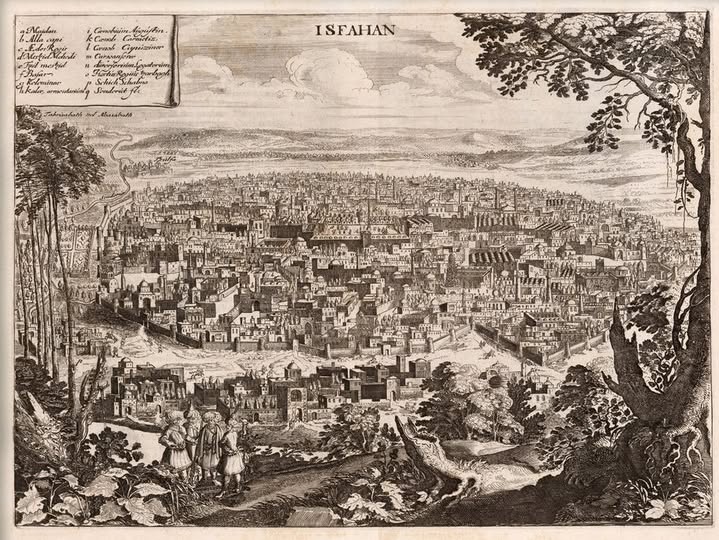
A note from 1663. I thought some may like to read this historic recount, so I share it here. It was transcribed & posted by the Portuguese academic & historian Miguel Castelo Branco, on his social media account. (As I've mentioned regarding other posts of his I've translated, though he speaks other languages he always makes it a point to publish on his social media account in his native tongue. I have his permission, but in any case, his posts are public, so there is no problem in them being shared). I also include the illustration he had placed. Here is my translation. In brackets, I will always add either a synonym to aid in terms of contextual meaning, any additional though optional word(s), or an alternative. ⤵️
Miguel Castelo Branco : Portugal in Persia
I have not leafed through it for almost ten years, but every time I return to it I am amazed by this beautiful text by Father Manuel Godinho, a Portuguese Jesuit priest who in 1663 made the trip from India to the Kingdom, touching (through) Persia, then ruled by Abbas II.
"As for the customs of the Persians, they are by nature mild; their language, very soft (smooth) ; they're very friendly and friends unto foreigners, enemies of thievery and robbers, which makes the whole kingdom safe for those who walk through it. All cases, whether civil or criminal, they judge verbally. (They do so) zealous of their sect, but not so brutally as the Arabs and Turks, because their taste (desire) is to dispute with the (devout) religious Christians - whence we see even the King rejoicing to hear them speak on such matters and to dispute them with his scholars. They are very fond of wine, and allow it to be made by the Christians of Ispaam and Shiraz, wherefrom it is brought to India; but it is not enduring, because it does not boil (ferment), as they say. They are exceedingly given to luxury (luxurious / lustful), not content even with many women; (they are) great soldiers and men of presence, cunning in war, but they do it only if highly provoked by their enemies, primarily to preserve their own than to conquer others. The weapons they use are chiefly bow and arrow, in which they boast of being as dexterous as the ancient Parthians, from whom they proceed; (having) cutlasses (falchions), maces, and some shotguns, (some) so long as I myself witnessed when seeing a Persian holding one measuring fifteen spans. There are no people in the world who ride horses so bizarrely as they do; they all ride on horseback using short stirrups and they move with grace and self-confidence (ease), even if somewhat encumbered by the rich silks with which they are clothed - the most common of these being quilted crimson satin, and Madder crimson cloths with many froggings of gold and Silk. The shirts are without cape (cloak), and the doublets are of one-piece (one-piece doublets) and collarless. Knee-length shorts, no more than knee length, (these are) unlike what those worn by Mongols. The robes are in the manner of *marmotas (Moorish cloaks), which go down to half the leg length, very tight-fitted on the body, and long sleeved - which the Turks do not have since all of theirs do not go beyond the elbow. They wear long sleeved robes, lined with ermines, sables and minks, which come to them from Muscovy and Tartary. Others, of lesser means, wear robes lined with the skins of foxes and lambs of their land which have a wool so fine that it looks like silk plush (lush silk pile), as can easily be seen via one that I have brought (back) to this kingdom. The Persians wear on their heads a white cap and a large and high hood, which is a twelve-gored hat - in the manner of 12 folds of a cap, which always appears above the (white) cap or turban, and these are called Queselbás (Portuguese styled word for the term Qezelbāš). This was the devised term that Ishmael Sofi, first bearer of the name, gave them. The heads are shaven with a razor, leaving at the top of it a small tuft of hair, in which – as they say – lays their vigor and strength as it was for Samson. Socks are always cochineal or Gran (deep red), tied above the knee. The shoes have come to be like our slippers, with heels in the back and with the ends turned up.
They, the Persians, aside from what I have said, are quite given to hunting which is abundant in Persia, both by horseback and by falconry, but the kind they like the most is that which is done with falcons, which – having this objective in mind – are bred & reared, thus those they have are very good. As they are much given to pleasure, they dare not enter the sea, hence the King of Persia not even having a single fusta (galliot) in the Strait to guard his islands and coastline. Their food is comprised of all kinds of green and dried fruits, and as for meat they only do not eat that which their law forbids being eaten, which is the kind that is acorn-fed. They rarely eat fish, and they never eat soups; their food (diet) is roast mutton, chicken dishes, partridges, beef and goat cooked with rice and butter. They are also very fond of meat fried in butter, rice braised in butter, with cinnamon, cloves and walnut; the table they set on the floor, upon carpets. The bread is not like ours, but made in the manner of cakes baked with fennel. Further particularities in wardrobe and eating can be seen addressed by António Tenreiro and Vicente Roca, who treat them diffusely."
GODINHO, Manuel - Relação do novo caminho que fez por terra e mar vindo da Índia para Portugal no ano de 1663. Lisboa: INCM, 1974.
⤵️
#MiguelCasteloBranco (the original post & respective link https://www.facebook.com/miguel.c.branco.5/posts/pfbid02Pz7NcUizpN1zq6BfqLvNtZzk7KgPvBXQLHGAKfH2mvxjkgdm6YdeA1ffq63Qqzegl )
« Portugal na Pérsia
Não o folheava há quase dez anos, mas cada vez que a ele regresso espantado fico com esse belíssimo texto do Padre Manuel Godinho, sacerdote jesuíta português que em 1663 fez a viagem da Índia ao Reino, tocando a Pérsia, então governada por Abbas II.
"No que toca aos costumes dos persianos, são brandos de condição; a língua, suavíssima; afabilíssimos e amigos de estrangeiros, inimigos de roubos e de ladrões, o que faz todo o reino seguro aos que por ele caminham. Todas as causas, quer sejam cíveis quer criminais, julgam verbalmente. Zelosos da sua seita, mas não tão brutalmente como os árabes e turcos, porque o seu gosto é disputar com os religiosos cristãos, folgando até o mesmo rei de os ouvir falar nestas matérias e disputar com os seus letrados. Gostam muito de vinho e deixam-no fazer aos cristãos de Ispaão e Xiraz, donde se leva para a Índia; mas não é de dura, por não ferver, segundo dizem. São sobremaneira luxuriosos, não se contentando nem com muitas mulheres; grandes soldados e homens de presença, ardilosos na guerra, mas não a fazem senão muito provocados de seus inimigos, e mais para conservarem o seu do que para conquistarem o alheio. As armas de que usam são principalmente arco e flecha, em que se prezam de ser tão destros como os antigos partos, de que procedem; alfanjes, maças e algumas espingardas, tão compridas que vi eu a um persiano uma de quinze palmos. Não há gente no mundo que se ponha a cavalo com tanta bizarria como eles; todos cavalgam à gineta e se meneiam muito airosamente, ao que não ajudam pouco as ricas sedas de que se vestem; a mais comum é cetim carmesim acolchoado, e panos de grã com muitos alamares de ouro e seda. As camisas são sem manteu, e os gibões inteiriços, sem abas. Os calções até ao joelho, não mais, ao contrário do que usam os mogóis. As roupetas são à maneira de marlotas, que dão por meia perna, no corpo muito apertadas, e mangas compridas, o que não têm os turcos, porque todas as suas não chegam mais que ao cotovelo. Usam de roupões com mangas compridas, forradas de arminhos, martas e gibelinas, que lhes vêm de Moscóvia e Tartária. Outros, de menos posses, trazem uns roupões com forros de peles de raposas e cordeiros da terra, que têm uma lã tão fina que parece felpa de seda, como bem se viu de uma que eu trouxe a este reino. Trazem os persianos na cabeça touca branca e um carapuço grande e alto, com doze vergas à maneira de dobras de gorra, a qual parece sempre por cima da touca ou turbante, e os tais se chamam queselbás. Esta foi a divisa que Ismael Sofi, primeiro deste nome, lhes deu. As cabeças rapam à navalha, deixando no mais alto dela uma guedelha pequena, em que dizem estar o seu vigor e força, como em Sansão estava. As meias são sempre de cochonilha ou grã, atadas por cima do joelho. Os sapatos vêm a ser como as nossas chinelas, com seus saltos atrás e as pontas reviradas para cima.
São, além do que tenho dito, os persianos muito dados à caça, que é abundante na Pérsia, tanto de montaria como de volataria, mas a de que mais gostam é a de falcões, que para isso criam e têm muito bons. Como são muito dados ao deleite, não se atrevem a entrar no mar, donde procede não ter o rei da Pérsia nem uma só fusta no estreito para guarda das suas ilhas e costa. O comer deles é todo o género de frutas verdes e secas, e de carnes só não comem a que a sua lei lhes proíbe, que vem a ser a criada com lande. Peixe comem raramente, e nunca sopas; o seu comer é carneiro assado, pratos de galinha, perdizes, vaca e cabrito cozido com arroz e manteiga. Também gostam muito de carne frita em manteiga, arroz refogado em manteiga, com canela, cravo e noz; a mesa põem no chão, sobre alcatifas. O pão não é como o nosso, mas feito à maneira de bolos cozidos com erva-doce. As mais particularidades no vestir e comer podem ver-se em António Tenreiro e Vicente Roca, que as tratam difusamente. "
GODINHO, Manuel - Relação do novo caminho que fez por terra e mar vindo da Índia para Portugal no ano de 1663. Lisboa: INCM, 1974. »