How did they manage to break the 200-ton Tsar Bell?
Imagine: a pit ten meters deep. In it lies a red-hot bronze colossus weighing two hundred tons. Fire rages all around. People rush about, carrying buckets of water. Someone shouts, "Fill it! Fill it, it'll be ruined!"
And the bell is already cracking.
So what happened to the largest bell in the world—and who really destroyed it? Let's find out.
Empress Anna Ioannovna
It all began in 1730. Empress Anna Ioannovna, who had just ascended to the throne, decided to assert her power loudly—literally. She signed a decree ordering the casting of a new bell for the Moscow Kremlin. But not just any bell. One the world had never seen before. The previous great bell, cast during the reign of Tsar Alexei Mikhailovich, weighed approximately 130 tons and was considered a wonder of its time. But it, too, broke—in 1701, during yet another Moscow fire. The bell fell from the belfry and shattered.
Anna Ioannovna set out to surpass her predecessors, aiming for two hundred tons of pure bronze. The new bell was to be the largest not only in Russia, but in all of Christendom.
The Parisian mechanic Germain was invited to implement the plan, but upon learning of the future bell's size, he considered the idea madness and refused. Then the Moscow foundry master, Ivan Motorin, took on the job.
An experienced and respected man, he had cast dozens of bells for Moscow churches. But even he understood: the scale of the order was staggering—nothing like it had ever been seen in the history of foundry.
The preparations dragged on for years. A huge pit, some ten meters deep, was dug in the Kremlin's Ivanovskaya Square. An entire complex was erected around it: foundry furnaces, lifting mechanisms, and wooden scaffolding. Hundreds of craftsmen and laborers worked on the project.
Ivanovskaya Square, Kremlin
The first attempt failed—metal leaked from the furnaces, a fire started, and part of the structure burned down. Ivan Motorin, exhausted by the impossible task, died in 1735, never seeing the result of his labor.
His son, Mikhail Motorin, continued the work. And on November 25, 1735, the result of five years of labor occurred: molten bronze—an alloy of copper and tin—filled the mold. Metal poured from four furnaces for thirty-six hours. The casting was a success.
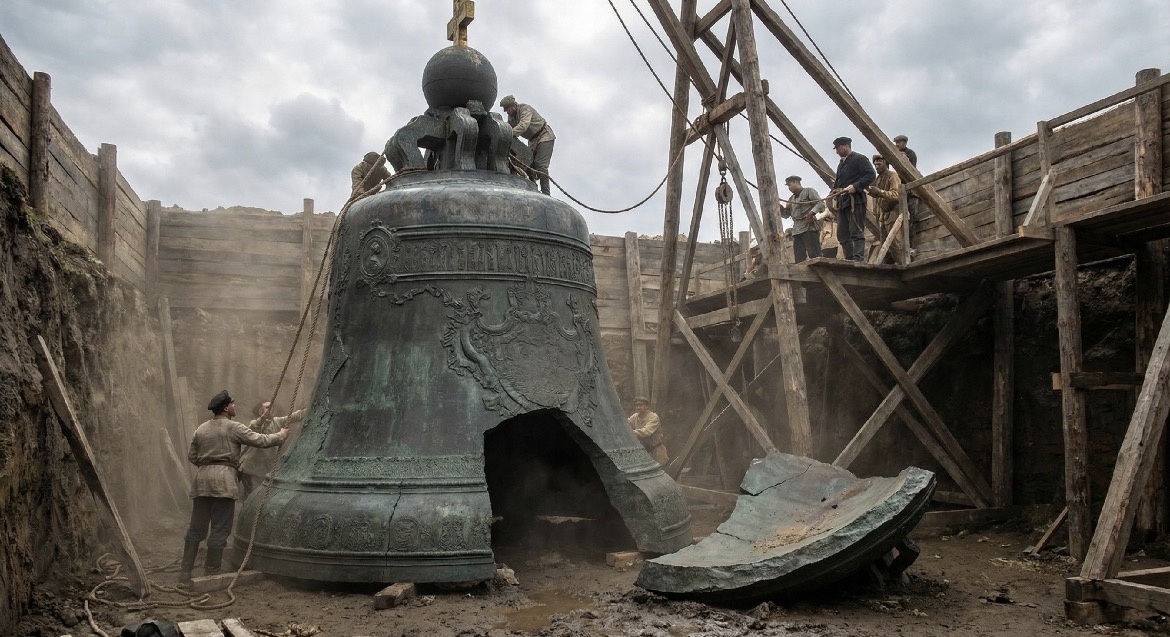
The bell was enormous. More than six meters high, almost as many in diameter. About two hundred tons of cast metal. The walls were decorated with bas-reliefs depicting the empress, saints, and lush decorative ornaments. These weren't just church vessels—they were a symbol of imperial power.
But the bell was never raised from the pit. It remained at the bottom for further processing and embossing.
And then disaster struck.
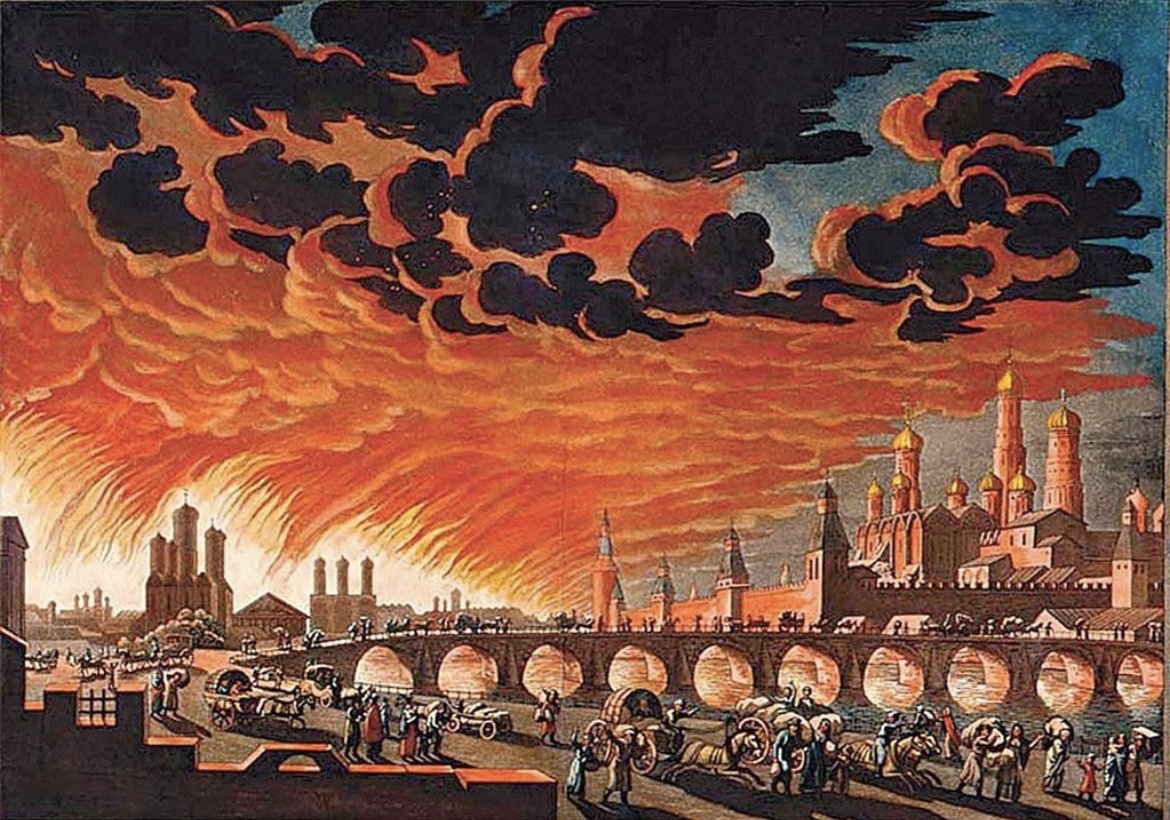
On May 29, 1737, the Trinity Fire broke out in Moscow—one of the largest in the city's history. The fire engulfed the Kremlin and Kitai-Gorod, and several thousand houses were reduced to ashes. The flames spread to the wooden buildings around the casting pit and engulfed the scaffolding. Burning logs and planks fell directly onto the bell.
And then something happened that is still debated to this day.
The Great Fire
According to the most widespread theory, people rushed to extinguish the bell by pouring cold water on the hot metal. The bronze couldn't withstand the temperature change. Cracks appeared across the bell's body. A chunk weighing approximately eleven and a half tons broke off. The chunk was almost two meters high—the size of a large furnace.
But was this really true?
Some researchers believe that water was indeed to blame: the rapid cooling of heated bronze inevitably leads to cracking. Others believe the cracks could have appeared during casting, due to manufacturing errors or uneven cooling of the metal in the mold. The fire merely completed the destruction.
There is a third theory: the bell could have cracked from the fall of heavy burning structures, not from the water. The wooden scaffolding surrounding the pit was quite heavy—if it had fallen, it could have struck the side of the bell with tremendous force.
There's no consensus among experts. For ordinary Muscovites of the 18th century, things were simpler: they said the bell was "not meant to be." They cast it—good. They didn't let it ring. So, that's God's will.
For almost a hundred years, the bronze giant lay in the ground. It was remembered, but the technical capabilities were insufficient to lift such a colossus. Several attempts were made to extract the bell: under Catherine II and Alexander I. All ended in failure. The bell seemed to be rooted in the Moscow soil.
Auguste de Montferrand
Only in 1836, under Nicholas I, did the architect Auguste de Montferrand—the same one who built St. Isaac's Cathedral in St. Petersburg—finally manage to extract the bell from the pit. The operation took several days, required complex engineering calculations, and the labor of hundreds of soldiers. The bell was installed on a stone pedestal at the foot of the Ivan the Great Bell Tower. There it stands to this day.
Nearby, on a separate stand, lies the very same broken piece. Eleven and a half tons of bronze—a silent reminder of the night that deprived Russia of the voice of the largest bell on earth.
Interestingly, in the 19th century, the idea of soldering the piece back and raising the bell to the bell tower was repeatedly discussed. But experts concluded that even if restored, the bell would not have sounded as its creators intended. The cracks would have changed the acoustics forever.
So who is to blame?
The Empress, whose ambition inspired this unprecedented concept? The craftsmen who perhaps made mistakes during the casting? The people who doused the molten bronze with icy water? Or the elements themselves—the fire that devoured wooden Moscow?
There is no definitive answer. And perhaps this is the greatest irony of the whole story. Seven years of work. Hundreds of craftsmen. Thousands of pounds of metal. The death of the chief foundryman. And all this for the sake of a bell that never rang.
I wonder what its voice would have been like.
And the Tsar Bell remained silent. The largest bell in the world—and the only one that never rang. Today, it is one of the main symbols of the Moscow Kremlin.
Tourists take photos with it, children touch its chipped edge. Few realize that before them is a monument not to greatness, but to defeat. To a grandiose plan that was never completed.