Weaker than a spider’s web: Hezbollah’s fiber thread traps the Merkava
A weapon measured in microns has cut through decades of Israeli military doctrine. What unfolded in southern Lebanon was not a surprise attack, but the exposure of a system built to fight the last war.
Anis Raiss, APR 24, 2026
It is a spool of glass the width of a human hair, wound inside a 3D-printed housing that weighs less than a bag of sugar.
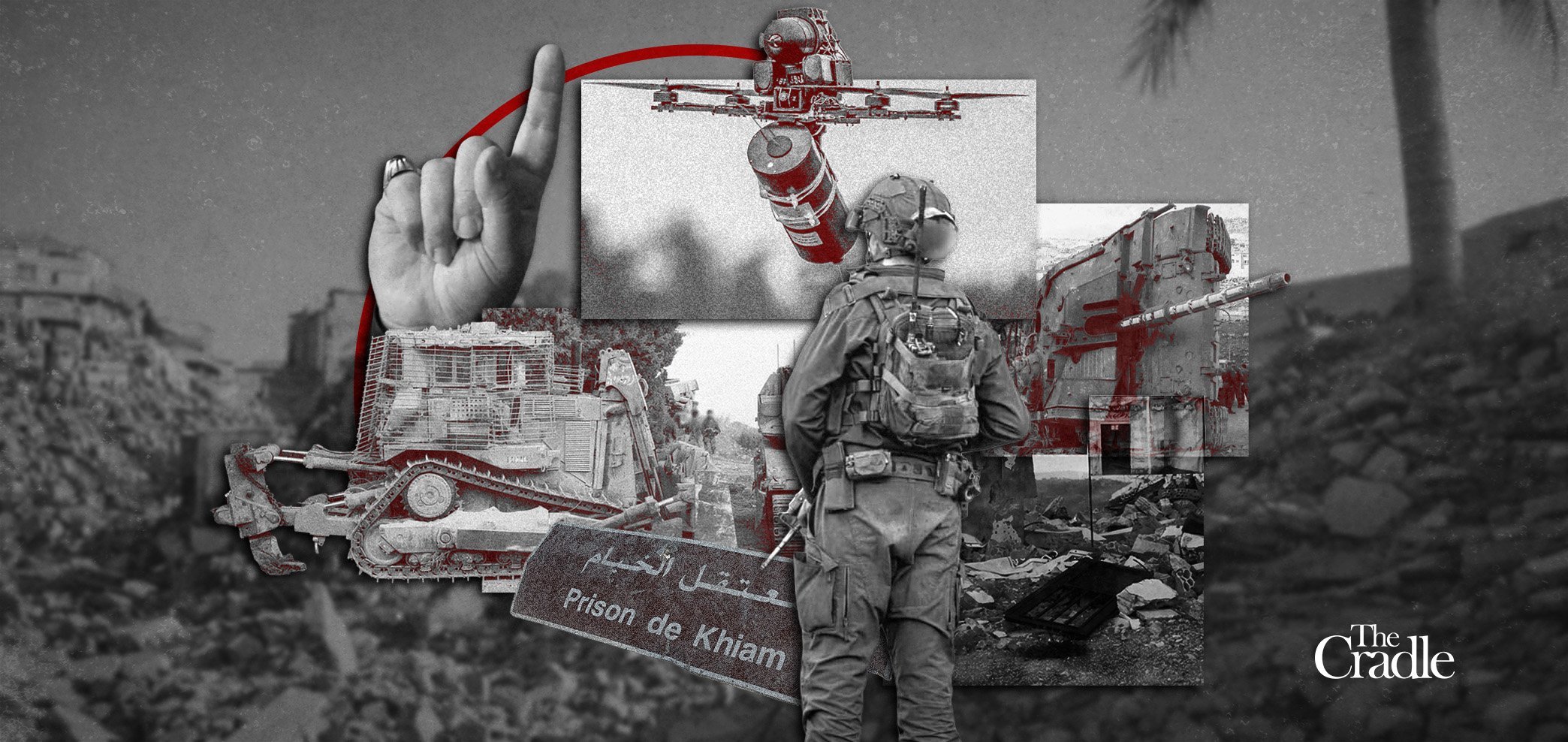
On 4 April, in southern Lebanon, it destroyed a Merkava Mk.4 main battle tank. The drone it trailed behind cost less than dinner for two in Tel Aviv. It arrived on no frequency. It crossed an airspace the occupation's radar could not map.
It was guided by a pilot the occupation's jammers could not silence. For two decades, the occupation state built an industry to stop a signal. Hezbollah sent a weapon thinner than the spider’s web that the late secretary-general Hassan Nasrallah once used to describe Israel’s fragility – a weapon that does not speak at all.
In the first week of April, in southern Lebanon, a Namer heavy infantry fighting vehicle – among the most heavily armored platforms the occupation army fields, mounting the 30mm Bushmaster cannon, a Spike missile launcher, and the Trophy active protection system designed to intercept incoming projectiles – was struck by a $500 drone.
The drone carried a Soviet RPG warhead from 1961, unwound a hair-thin fiber-optic cable behind it as it flew, and approached a target whose entire defensive logic was built around a frequency the drone was not transmitting on. The War Zone reported the strike alongside confirmed hits on two Merkava Mk.4 tanks and a D9 bulldozer in the same window. Trophy, the system Rafael marketed as the answer to the next war, had met a weapon that does not emit.
An ambush years in the making
The occupation army's 7th Brigade is not an ordinary armored unit. It fought at the Valley of Tears in 1973 and has served as Israel’s primary armored reserve on the northern front for half a century. On 25 March, its engineers sent a remotely operated D9 bulldozer north from Muhaysibat to probe the resistance's defensive lines between Taybeh and Qantara. Hezbollah fighters watched the bulldozer pass through their fire arcs and let it go. They were waiting for what came next.
At 6:50 pm on Wednesday, 26 March, an armored column advanced in single file along the same route the decoy had taken. The resistance engaged the middle element first – four Merkava Mk.4 tanks and a D9, destroyed in one coordinated salvo using Almas anti-tank guided missiles reverse-engineered from the occupation's own Spike.
The rear platoon deployed smoke. Fire found it through the smoke. The lead element pushed toward Qantara's fuel depot and was destroyed there. Inside two hours, 10 Merkava tanks and two D9 bulldozers lay burning.
The surviving soldiers abandoned their vehicles and walked out on foot. Military Watch Magazine described the incident as the heaviest Israeli armored losses in over 40 years. A doctrinal demonstration, using weapons Tel Aviv had long cataloged, jammed, and planned for.
The wire they cannot jam
A fiber-optic drone is a first-person-view quadcopter that trails a glass cable two to three tenths of a millimeter thick from a spool mounted between the frame and the payload. Control signals and live video travel down the fiber as pulses of light.
There is no radio transmission to hear. There is no electromagnetic emission to classify. There is no frequency on which the drone can be addressed and therefore no frequency on which it can be answered. The drone is, to every instrument in Rafael's and Elbit's counter-UAS catalog, a silence walking toward a target.
The absence is absolute. Systems like Drone Dome, built by Rafael – the same firm behind Iron Dome – and Elbit’s ReDrone are designed to detect, classify, and disrupt radio signals. Israel Aerospace Industries’ Drone Guard operates on the same premise. When the signal is replaced by a strand of glass, the architecture remains active but irrelevant. The radar turns. The jammer pulses. Nothing meets the drone before impact.
Russian forces first deployed fiber-optic FPVs against Ukrainian armor in spring 2024. By summer, spools of 10 to 20 kilometers were standard across the front. By December 2025, Chinese manufacturer PGI Technology was advertising spools extending to 60 kilometers, supplied to both Russian and Ukrainian producers.
For 18 months, the occupation state's defense planners watched a weapon proliferate across the Ukrainian theater that its entire counter-drone architecture had no answer to.
In the first week of April 2026, Hezbollah operators flew these drones against a Trophy-equipped Namer heavy IFV, two Merkava Mk.4 main battle tanks, a D9 Caterpillar bulldozer, and an Eitan armored personnel carrier.
The drones carried PG-7 shaped-charge warheads – the Soviet rocket-propelled grenade design that entered production in 1961, now bolted onto a plastic frame and flown into the thin armor above the turret by a pilot sitting in a basement in southern Lebanon.
The defense analyst Shahryar Pasandideh observed that the feeds stay clean even at low altitude, through buildings, through foliage – the signature of a fiber link no radio drone can match. The Israeli army's own military correspondent at the Times of Israel conceded the point on 2 April: the fiber “mitigates efforts to electronically jam their signal.”
It was the confession that the most expensive counter-drone architecture in the world had met a wire and gone quiet.
A doctrine turned inside out
A fiber-optic FPV drone costs around $400 to $500. The assembly designs, according to the Foundation for Defense of Democracies, were transferred from the Russian army. The frames are printed.
The spools are sourced from China. The warhead is a Soviet RPG design that entered production in 1961. The Merkava Mk.4 can destroy targets worth between six and ten million dollars, protected by the Trophy system, widely presented as the most combat-tested active protection system in service.
In April, the Israeli Ministry of Defense Procurement Directorate issued a tender for 12 thousand first-person-view drones to be manually piloted by operators in virtual-reality goggles. The bidders included Xtend, Ondas, and Robotican.
The tender specifications matched, almost line for line, the weapons Hezbollah had already been flying into Merkavas for three weeks. The occupation army had spent 20 years exporting the doctrine that Israeli technology could answer every threat from the sky. It was now placing emergency orders for the threat itself.
The meaning of the battlefield
Sarit Zehavi, a former lieutenant colonel in the Israeli army’s Military Intelligence Corps and current head of the Alma Research Center, told the Washington Examiner that this war differs from the previous one in both scope and objective:
“It's more difficult because the goal is different. The goal in 2024, the ground invasion, not the whole campaign, was to remove the threat of invasion by Hezbollah. This means that IDF maneuvered only very close to the border.”
The goal in 2026 was to reach the Litani. The border itself was where the resistance chose to fight, and it was there that the armored columns stopped.
Over the same period, the Israeli army carried out the destruction of two symbolic sites in southern Lebanon.
On 23 March, satellite imagery confirmed the demolition of the notorious Khiam detention center – once a prison run by the South Lebanon Army (SLA) under Israeli occupation.
Israeli media claims that on 12 April, the 98th Division leveled the stadium in Bint Jbeil where Nasrallah had delivered his “spider’s web” speech in 2000. Standing in the ruins, Brigadier General Guy Levy declared, “There was someone here who spoke and boasted about webs and spiders. Today, that man no longer exists, the stadium is gone, and his words are worth nothing.”
The statement collapses under its own logic. The words derived their force from the reality they described. The army is still there. The stadium is not. Five divisions could not hold Khiam. They accepted a ceasefire with tanks burning in Qantara and villages unentered.
In May 2000, Nasrallah stood in that stadium and called the occupation state weaker than a spider's web.
A quarter of a century later, the metaphor has taken form. The thread is fiber, carrying no signal, wrapping itself around an army built for a different fight.
https://thecradle.co/articles-id/37325