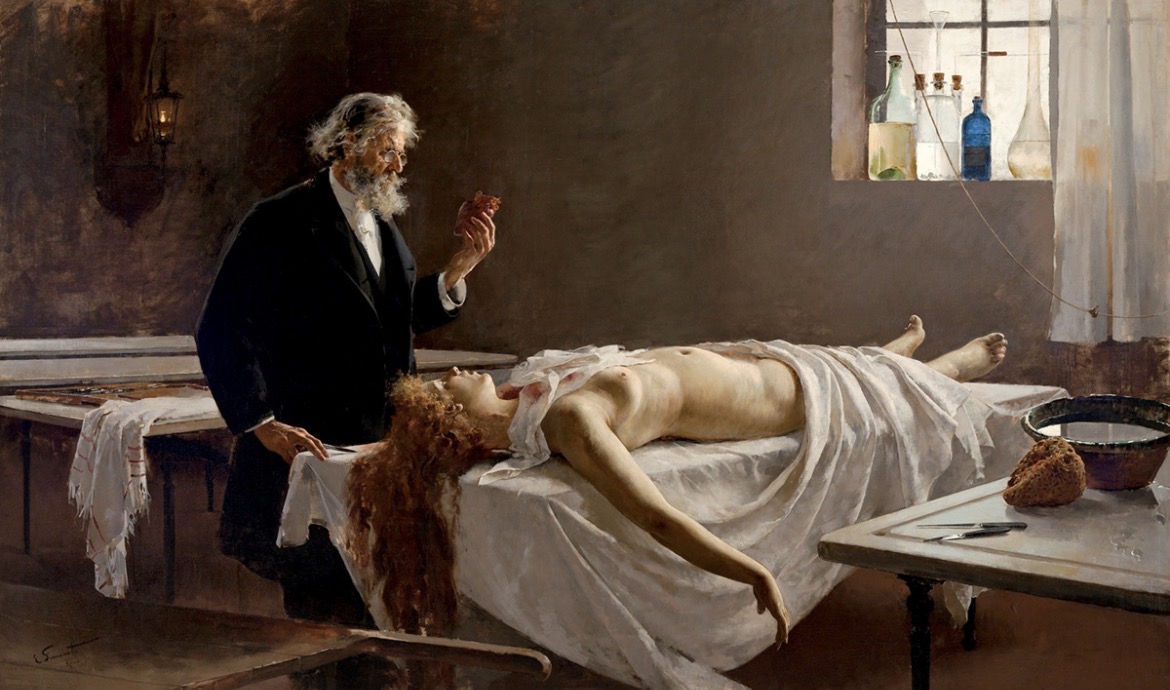
The painting "Autopsy" by Enrique Simone
While on a scholarship in Rome, the Spanish artist Enrique Simone (1866-1927) wrote to his father on January 20, 1890:
I have begun sketching for my work, which I must present at the end of my first year of study. It is a subject on a contemporary theme—the dissection of a heart. My choice of subject may seem surprising to you, but since it is extremely difficult to please the jury, I settled on this particular subject to see if it resonates with them. I will not describe the painting to you, as you will not be able to form a proper impression without seeing it in person. Later, I will send you a photograph for you to show to Mr. Muñoz [Degrain], whose very authoritative opinion I would like to obtain before I begin painting.
He quickly completed the preparatory work, and three months later, on April 29, he informed his father:
Tomorrow I'm going to the hospital for the last time to make a study from a model (now deceased), and this same week I'll finish my final work.
And indeed, on May 1, he presented the painting—classified as a study study of a nude—to Vicente Palmaroli, the director of the Roman Academy.
Although the work was expected to be shown at that year's National Exhibition, the scholarship holders' paintings were not delivered from the Gianicolo Hill in time to be included in the competition program; as a result, from mid-June onward, they were exhibited in the upper galleries of the Accademia di San Fernando.
Critics generally agreed that this particular student work was the most outstanding of all those submitted.
The only one to criticize the painting was Ceferino Araujo, citing its
repulsive subject matter, evoking nothing but revulsion,
though he at least acknowledged the masterful execution of the male figure.
This venerable critic perceived a
lack of masculinity in the painting,
to which the young art historian and artist Antonio Canovas y Vallejo countered that Simone
was entirely committed to those manifestations of masculinity characteristic of the modern school.
The younger generation of artists and critics received this painting with enthusiasm, praising it as the most striking example of the realistic renewal taking place in Spanish painting—a renewal that manifested itself both in the formal execution and in the thematic content of the work; In this regard, certain nuances pointed out by the painting's defenders deserve special attention.
Cánovas insisted that the artist
set aside all "costume" themes [...] and focused on exploring the theme [...], couched and presented in a contemporary style;
Furthermore, he considered him a thinker—
and a profound thinker
—by virtue of the very concept of the work.
Yet Luis Alfonso made an important clarification:
Anyone who rejects this painting for being "too" realistic is deeply mistaken [...]. There is poetry in Simone's painting—a dark, painful poetry, in the spirit of Edgar Allan Poe, if you will, but poetry nonetheless."
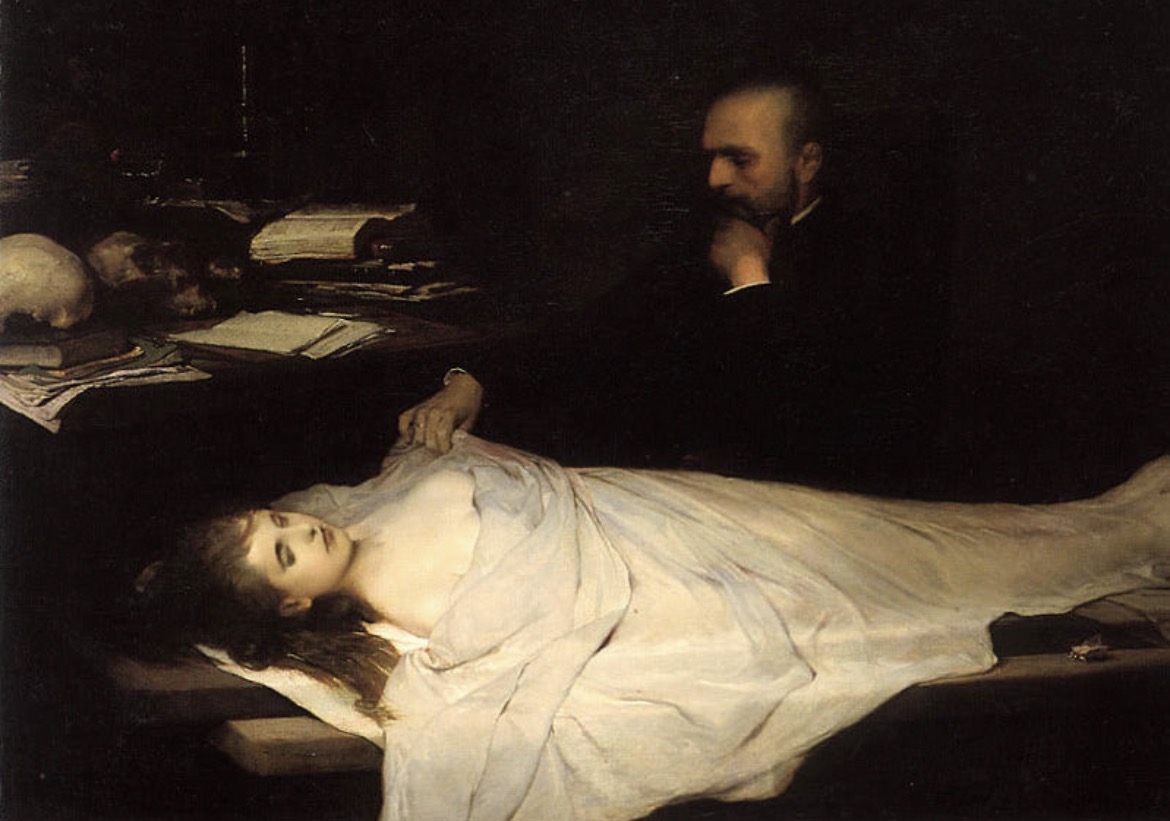
His insightful connection of this work to Romantic Gothic—inspired by the doctor's demeanor (more contemplative than clinical)—reveals the painting's hidden Symbolist meaning and connects it to European models the artist may have been inspired by: in particular, Gabriel von Max's "The Anatomist" (1869; Munich, Neue Pinakothek)
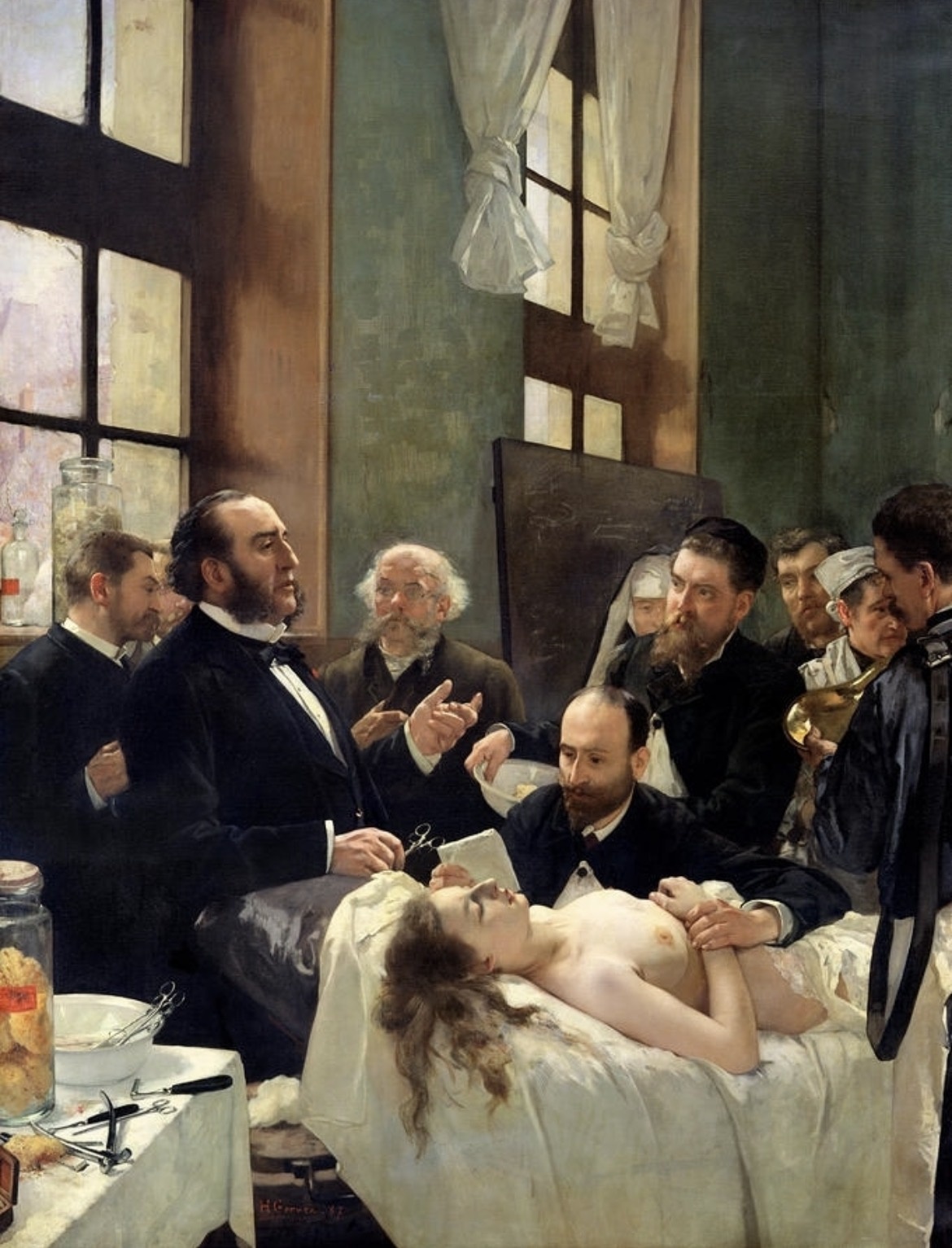
and Henri Gervex's "Jules-Émile Péan and His Surgical Class Before the Operation" (1887; Paris, Musée d'Orsay)
—works that served as precursors (especially the former) to a darker current in Symbolism.
In these works—as in the Prado painting under consideration—it is men who examine women's bodies (and in this particular image, the heart is treated as a metaphor for a woman's feelings); This represents the highest form of hegemony over the female body—a dynamic that was characteristic of the scientific iconography of 19th-century realism.
The most frequently cited, albeit erroneous, title of this work is "Y tenía corazón" ("And She Had a Heart" )—a designation that arose precisely from this emphasis on patriarchal interpretation.
In light of this, it is not surprising that all sorts of speculations have arisen regarding the identity, circumstances of death, or past of the deceased the artist studied, just as subjective judgments have been made regarding her appearance.
Be that as it may, the work has enjoyed a long and rich afterlife in popular culture—aided by numerous mechanical reproductions of varying quality—as well as in the art world, notably in Barbara Kruger's "No Radio" (1988; San Francisco Museum of Modern Art).