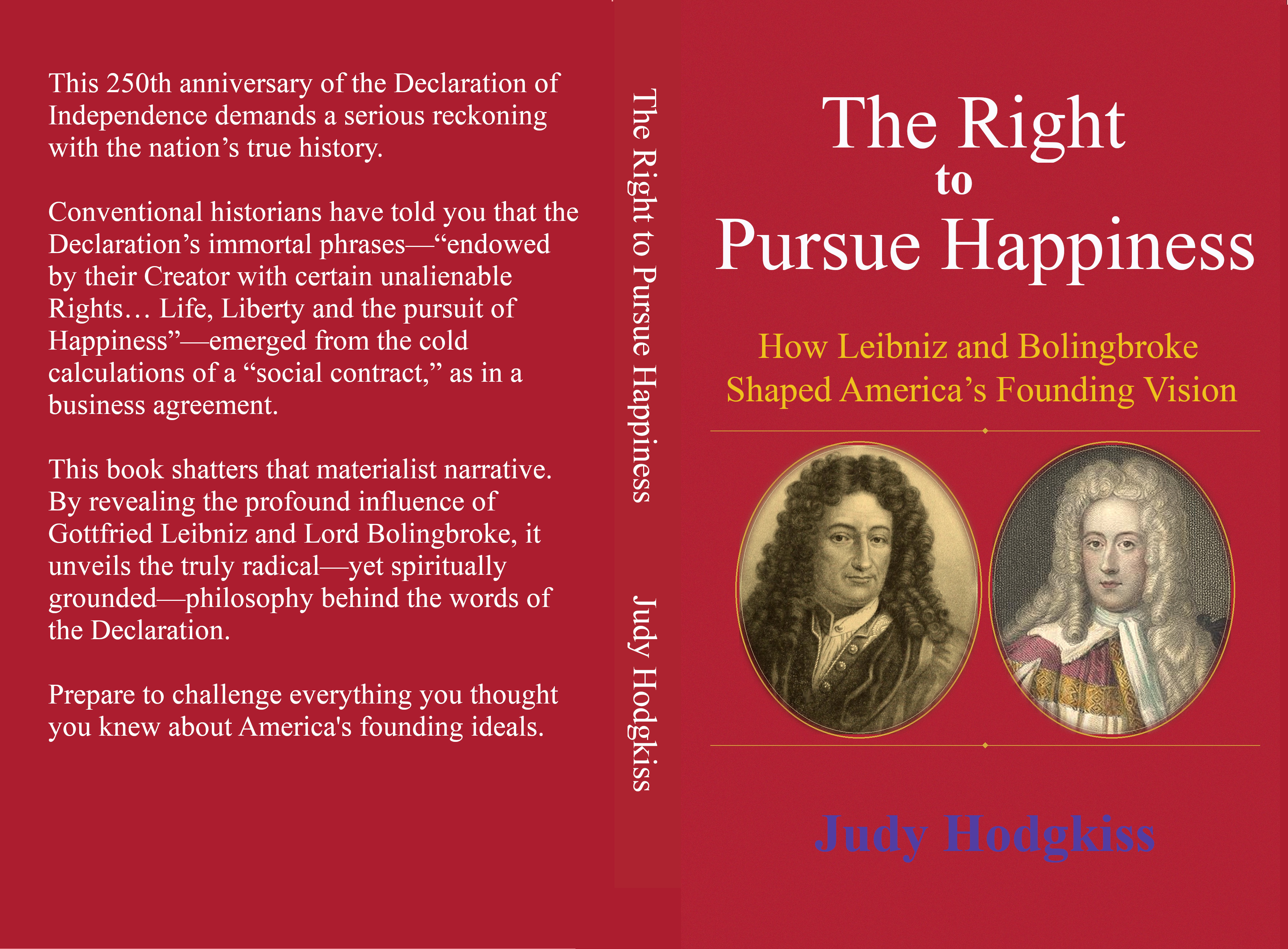
Saturday July 11th: Catch my second class on my new book, "The Right to Pursue Happiness: How Leibniz and Bolingbroke Shaped America’s Founding Vision". Zoom Info below.
Note: Even if you have not seen the first class yourself, you can tell from a few of the comments on the YouTube video that people were sometimes dismayed by the discrepancy between the quality of the material being presented and the presentation itself. But you will see me tomorrow make the effort to “tighten up” the delivery. (It can only make you appreciate the talents of our webcasters here on Locals!)
Buy the book on Amazon:
https://www.amazon.com/gp/aw/d/B0H68GVKCV/ref=tmm_pap_swatch_0?th=1&psc=1
Saturday Class—July 11—6pm et/3pm pt
Judy Hodgkiss and Tony Papert
How did Bolingbroke Bring Leibniz' Ideas to America and into our Declaration of Independence?
Hints to the answer surround us in everyday life.
Consider, for instance, the #3 movie in theaters right now—“Young Washington,” from the independent studio Angel Studios—which premiered on the 250th anniversary of the Declaration’s signing. In an early scene, a 20-year-old George Washington notices Lord Fairfax slipping away from his own lively party to retreat into his library. Washington follows him, introduces himself, compliments the older man on his impressive collection, and follows up with a question for the lord: do you, sir, have a copy of Alexander Pope’s Essay on Man?
Whether the writers and producers at Angel Studios realize it or not, this seemingly small detail does more than illustrate Washington’s voracious appetite for literature. It quietly points to one of the key channels through which Leibnizian ideas reached the American Founders: the intellectual collaboration between Lord Bolingbroke and Alexander Pope, which produced the Essay on Man.
Judy Hodgkiss will explore this further in Part II of her class on her new book, The Right to Pursue Happiness: How Leibniz and Bolingbroke Shaped America’s Founding Vision. She will show how, through this and other initiatives by Bolingbroke and his circle, the Leibnizian philosophy of reasoned optimism made its way into the colonies and eventually provided the intellectual and spiritual foundation for the words in the Declaration of Independence.
Join the class this Saturday:
https://us06web.zoom.us/webinar/register/WN_gtbh2cPoQHiIjIVulcFYjg#/registration
Blurb for the book:
2026 marks the 250th anniversary of the Declaration of Independence—a momentous milestone that calls for a serious reckoning with the nation’s true history.
Conventional historians would have you believe that the Declaration’s immortal words—“endowed by their Creator with certain unalienable Rights, that among these are Life, Liberty and the pursuit of Happiness”—emerged from the cold calculations of a “social contract,” as though they were mere clauses in a business agreement.
This book shatters that materialist narrative.
By revealing the profound influence of Gottfried Leibniz and Lord Bolingbroke, it unveils the truly radical—yet spiritually grounded—philosophy behind the words of the Declaration.
Prepare to challenge everything you thought you knew about America's founding ideals.