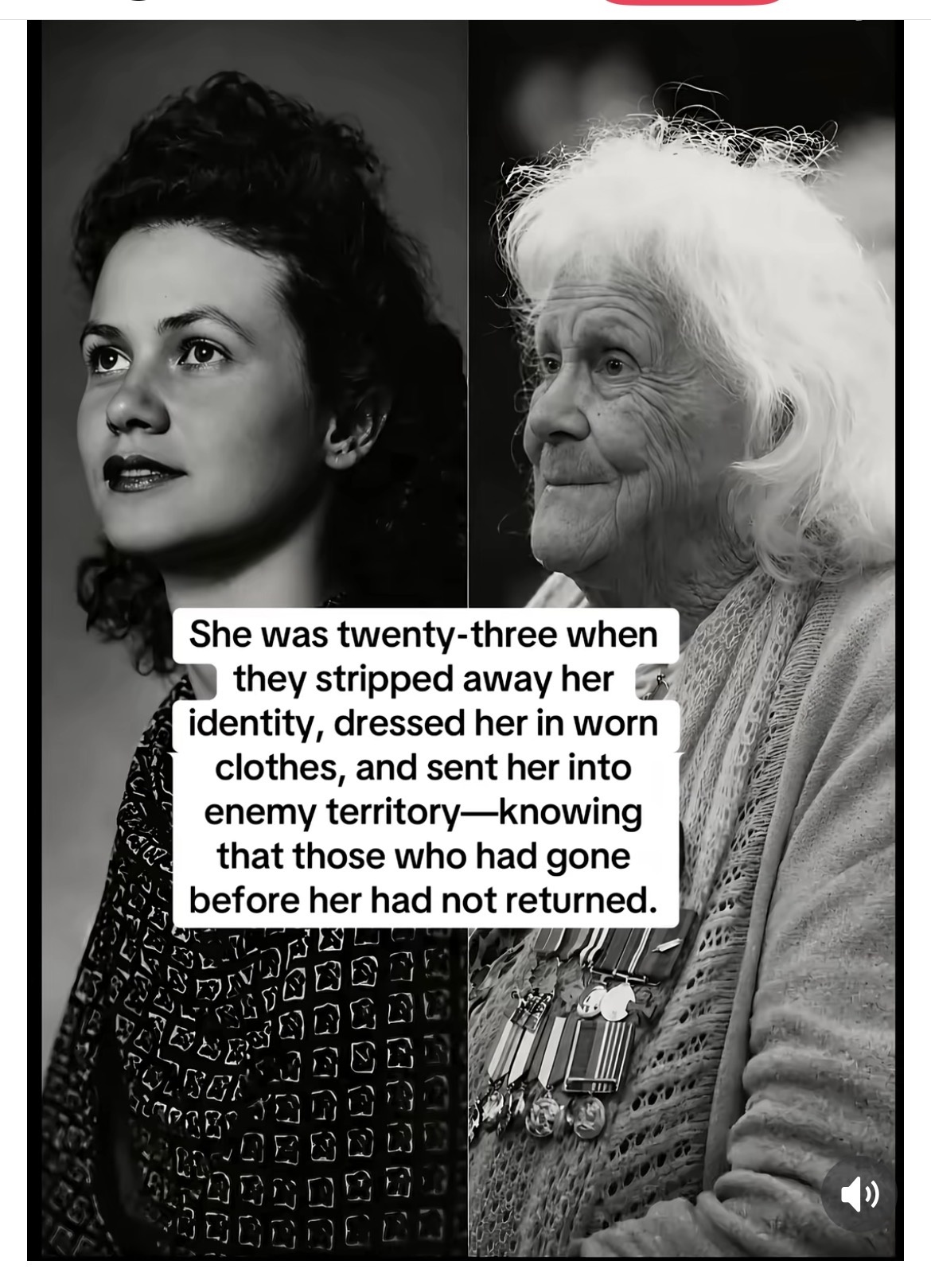
She was twenty-three when they stripped away her identity, dressed her in worn clothes, and sent her into enemy territory—knowing that those who had gone before her had not returned.
May 1, 1944.
Just days before D-Day.
The aircraft hatch opened over occupied France. Cold air surged in. Below her stretched a land under Nazi control
—watched, guarded, unforgiving. This was not just a mission. It was a disappearance.
Her name was Phyllis Latour Doyle.
She stood ready to jump, fear present but controlled.
She knew the risks. Capture meant torture. Torture often meant death. That had been the fate of others before her.
So British intelligence changed strategy.
They chose someone who would not appear dangerous.
They chose a woman.
Not because she was weaker-but because she could become invisible.
In the Scottish Highlands, she trained without pause.
Morse code until it became instinct. Radio work under pressure. Survival, evasion, resistance to interrogation.
She learned how to move unnoticed, how to disappear when needed. This wasn't theory—it was preparation for a reality where mistakes meant death.
Her mission was personal. The war had already taken people she loved.
Her cover was precise: a teenage French farm girl. Quiet.
Poor. Forgettable.
She wore simple clothes and learned to appear naive— to smile easily, to ask harmless questions, to be ignored.
Others had failed because they drew attention. She would survive by appearing ordinary.
That night, she jumped
She landed in Normandy, hid her parachute before dawn, and stepped into a new identity. By morning, she was traveling through villages on a worn bicycle, pretending to sell soap.
But every movement had purpose.
At checkpoints, she played her role-curious, harmless, insignificant. While soldiers dismissed her, she observed everything—troop movements, equipment, routes. She stored it all in memory.
Then she disappeared again.
In barns, forests, and abandoned buildings, she assembled her radio and sent coded messages back to London. German tracking teams could detect transmissions quickly, so she never stayed long. She kept moving, sleeping wherever she could, always aware of the danger around her.
Her codes were written on silk and hidden in her hair ribbon. After each use, she marked them carefully so they could not be reused.
Once, she was stopped and searched. Her belongings were checked. Then a soldier pointed to her hair.
"What is that?"
Without hesitation, she removed the ribbon, letting her hair fall loose. The silk code was right there-but it appeared ordinary. The soldier looked at it briefly and waved her on.
For four months, she lived this way—riding, observing, remembering, transmitting.
She sent 135 coded messages—more than any other female agent in occupied France. Those messages guided operations, supported planning, and saved lives.
They contributed to one of the most decisive moments of the war.n
When Paris was liberated in August 1944, her mission ended. Against all odds, she had survived.
And then, quietly, she disappeared once more.
After the war, she chose a different life. She married, moved to New Zealand, and raised her family. She rarely spoke about what she had done. Even those closest to her did not fully know.
Years later, the truth surfaced. When asked, she confirmed it simply—without pride or drama. It was something that needed to be done.
In 2014, France awarded her the Légion d'honneur. She accepted it quietly, just as she had lived.
Phyllis Latour Doyle passed away in 2023 at the age of 102, having outlived the regime that once hunted her.
Her story is not widely known. There are no grand monuments marking her path.
But somewhere in history, lives were saved because of her.
Because sometimes, history is shaped not only by leaders or battles— but by quiet courage, hidden in plain sight,
and a young woman who stepped into the unknown... and jumped anyway.