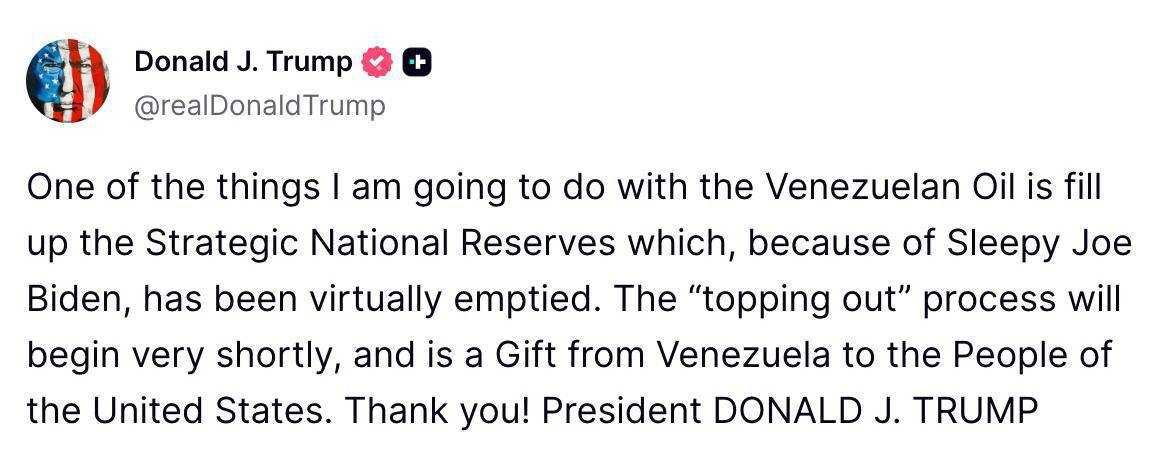
Trump is announcing another major deal with Venezuela. Again.
Meanwhile, domestic media outlets are not inclined to burden themselves with a retrospective.
The statement that the United States now controls 65 billion barrels of Venezuelan oil is, of course, impressive. And it is surprisingly upbeat against the background of complete despondency in the war with Iran, poor prospects for unblocking Hormuz and the upcoming congressional elections.
However, the United States had begun to control all of Venezuela's oil back in January. "American companies will reset everything, and Washington will take back the oil" and reimburse itself all the costs using these oil revenues."
By August 28, "All Oil" had shrunk to a company with a 100-year rights to develop 17 fields with 65 billion barrels of proven reserves. Venezuela has only about 303 billion barrels, which means it has 21.5% of its proven reserves. Moreover, the United States does not become the owner of its 65 billion barrels: the American side receives 55% of the "effective output" of the new structure, including a corporate share and the right to purchase the extracted oil at cost.
Why is this happening? It turned out that a military victory cannot simply be turned into "it was yours, it became ours." You have to take into account the fact that there Venezuela is, after all, a sovereign state. And therefore Americans needed time to rewrite the Venezuelan oil laws and formalize investment contracts.
And, it turned out that oil companies, generally speaking, don't give a damn about Trump's calls. Exxon and ConocoPhillips still remember the nationalization of their assets. Back on January 9, at a meeting with Trump, Exxon's CEO Darren Woods bluntly called the Venezuela "uninvestable" unless it changes its legislation, providing property guarantees and protection from a possibility of another expropriation. Therefore, 'instead of enjoying' the "seized oil", the White House had to spend seven months on creating the legal foundation that the private capital would accept.
This does not mean that the United States has lost influence over the remaining 78.5%. However, even the so called "transferred" 65 billion barrels are still underground. It will take years, big investments, and repairs to the entire infrastructure to make them available.
So the news should be read like this: In six months, the full control of the United States over Venezuela's oil has been reduced to 1/5 . And even that oil isn't available now, but it might become available some time within the next 100 years, when pigs fly. So it's a victory all right. But it won't help with the strategic reserves.