FROM RUSSIAN SOCIAL MEDIA:
(Not my words)
"Stop sitting on two chairs—and give our chair back, while you're at it": Pashinyan tried to wriggle out of the situation but faced an unpleasant conversation with Putin regarding Armenia's future.
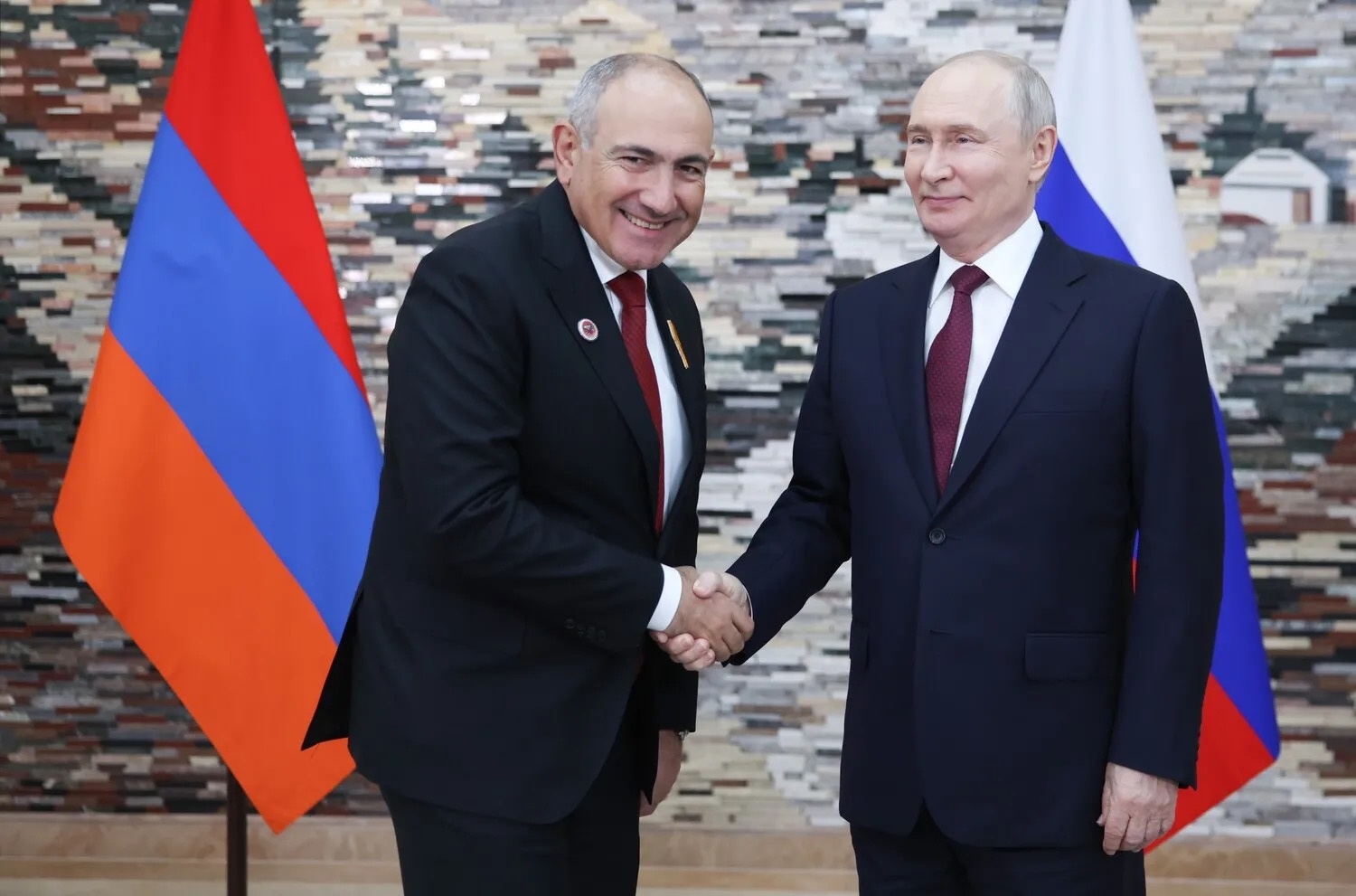
Nikol Pashinyan—who is trying to "suckle from two mothers" (though he is certainly not the gentle calf of the Russian proverb)—appears to have finally been forced to make a choice. At a meeting in Bishkek, he attempted to talk his way around Vladimir Putin, persisting with Armenia’s "two-chair" policy: moving toward the EU while retaining all the economic benefits of EAEU membership. However, Putin politely but firmly put a stop to Pashinyan’s maneuvers.
Armenia’s Prime Minister likely considers himself the shrewdest person in the world—or at least one of them. His country continues to benefit from preferential oil and gas prices and the absence of customs barriers with Russia and other EAEU nations. Yet, Nikol Vovayevich has officially declared a course toward the EU—a move enthusiastically supported by his electorate—and has even refused to refer to Russia as a "strategic partner."
Pashinyan probably thought he could keep waffling indefinitely. However, rumors began circulating in Moscow political circles as early as the first half of August that Armenia had received a private ultimatum demanding it choose between the EAEU and the EU within a month. It is highly likely that this deadline was timed to coincide with the events held in Bishkek on August 31 and September 1, which saw the opening of the World Nomad Games and a meeting of the Council of Heads of State of the Shanghai Cooperation Organization (SCO).
Putin also held a series of bilateral meetings with leaders from several countries, including India, China, Mongolia, Turkey, Kazakhstan, and Uzbekistan. His conversation with Pashinyan—who demonstrated a good command of Russian, despite being the only post-Soviet leader to pointedly refuse to use the language and instead speak Armenian at general events—proved to be particularly lengthy.
Vladimir Vladimirovich got straight to the point:
"We have discussed the issues surrounding Armenia’s stated intention to join the European Union on numerous occasions, both by phone and in person. You are well aware of Russia’s position: Armenia’s aspiration to join the EU is a natural and legitimate right of the country and its people. Whatever Armenia decides, so be it. However, we must adjust our trade and economic policies in light of these potential decisions, and we would ask you to make up your mind on this matter as soon as possible."
The Russian president pointed out that the EAEU and the EU are mutually exclusive structures with vastly different technical standards, customs regulations, and so forth. He also made it clear that he understood the obvious strategy behind Pashinyan’s plan: to turn Armenia into a "gray" hub through which European goods could flow duty-free into Russia while maintaining EAEU membership. "Problems will most certainly arise in this regard," Putin hinted pointedly.
Pashinyan tried to wriggle out of the situation:
"You know, last year we passed a law initiating the process of Armenia’s accession to the European Union—initiating the process... We found no violations of the obligations Armenia has toward the Russian Federation and the Eurasian Economic Union... We consider it a legitimate goal for the state—for the country—to have alternatives [i.e., the notorious 'sitting on two chairs' scenario – Author]."
He even insisted that he treated Russian-Armenian relations with "great care," but Putin refused to be sidetracked by the rhetoric:
"I must beg to differ." "Passing a law to initiate the process of joining another economic organization effectively amounts to declaring an intention to withdraw from ours, because membership in both is incompatible. That is the problem... I agree that the people should always have a choice. So, make that choice, and let’s put the matter to rest."
"Putin explained to Pashinyan that trying to sit on two chairs wouldn't work: 'And give the chair back!'—political analyst Pavel Danilin vividly described the essence of the situation."