FROM RUSSIAN SOCIAL MEDIA:
(Not my words)
No Great Patriotic War. What would have happened if Germany had honored the Molotov-Ribbentrop Pact?
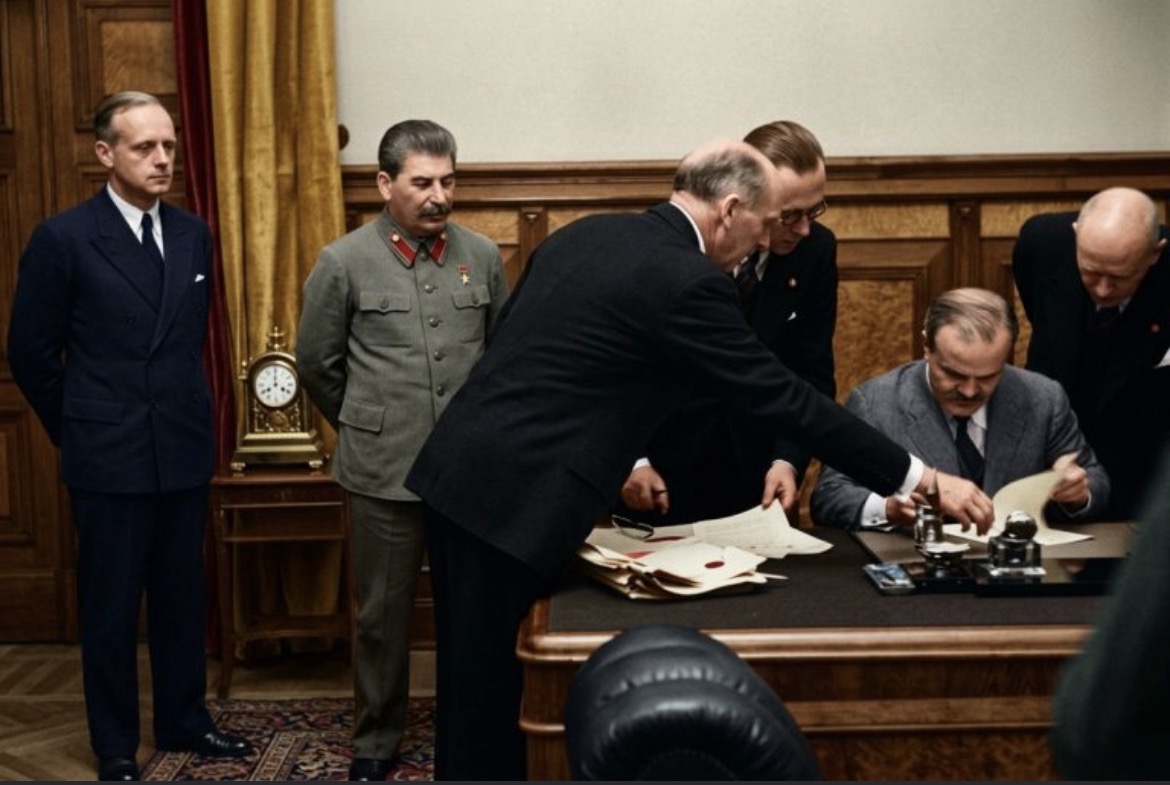
The Molotov-Ribbentrop Pact is one of those historical agreements discussed primarily because they were violated. On August 23, 1939, the USSR and Germany signed a non-aggression pact; less than two years later, on June 22, 1941, German troops crossed the Soviet border. Operation Barbarossa began, turning the Eastern Front into the main land theater of World War II and ultimately becoming a primary cause of the Third Reich's downfall.
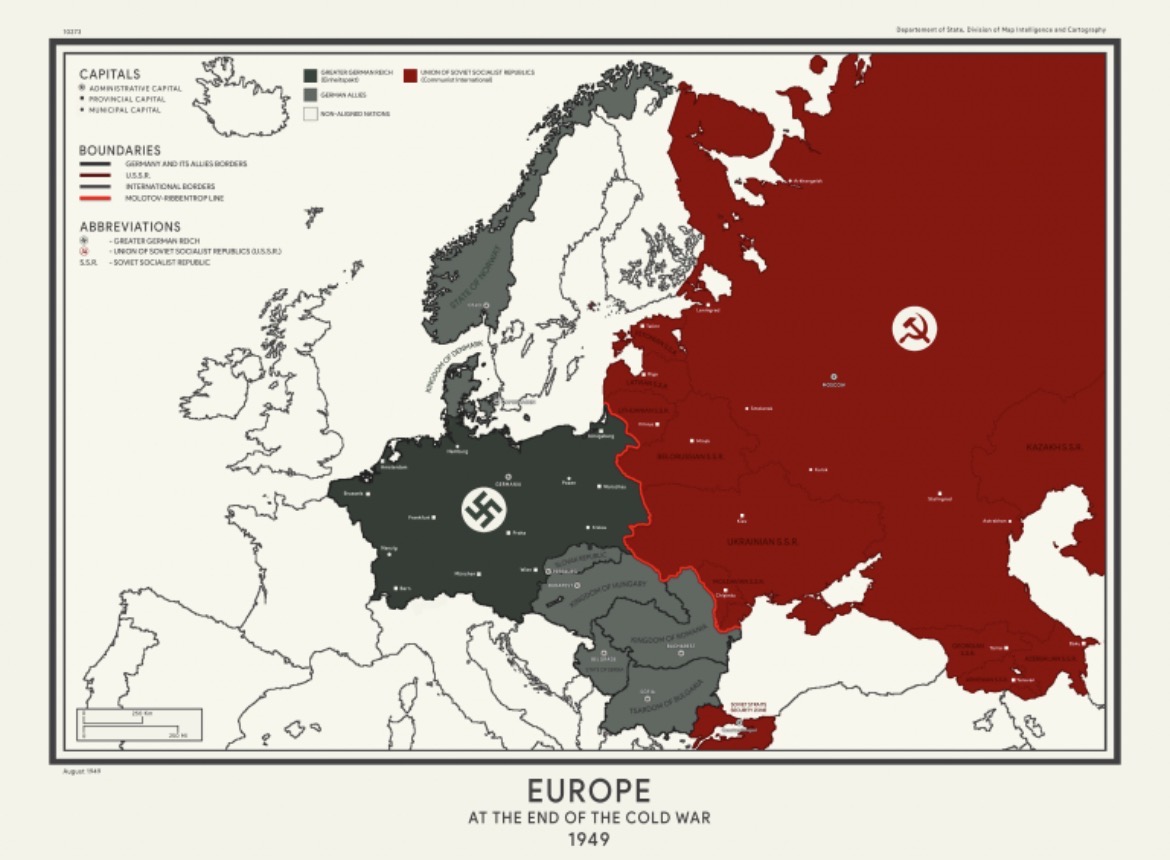
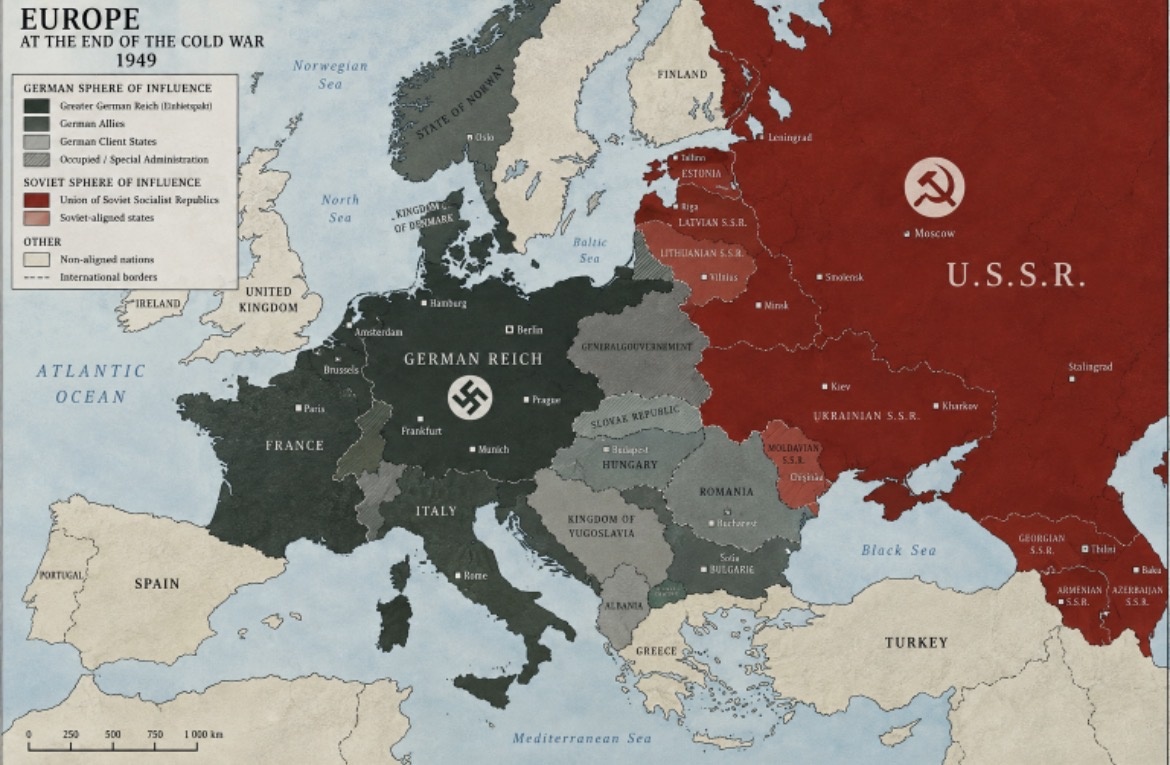
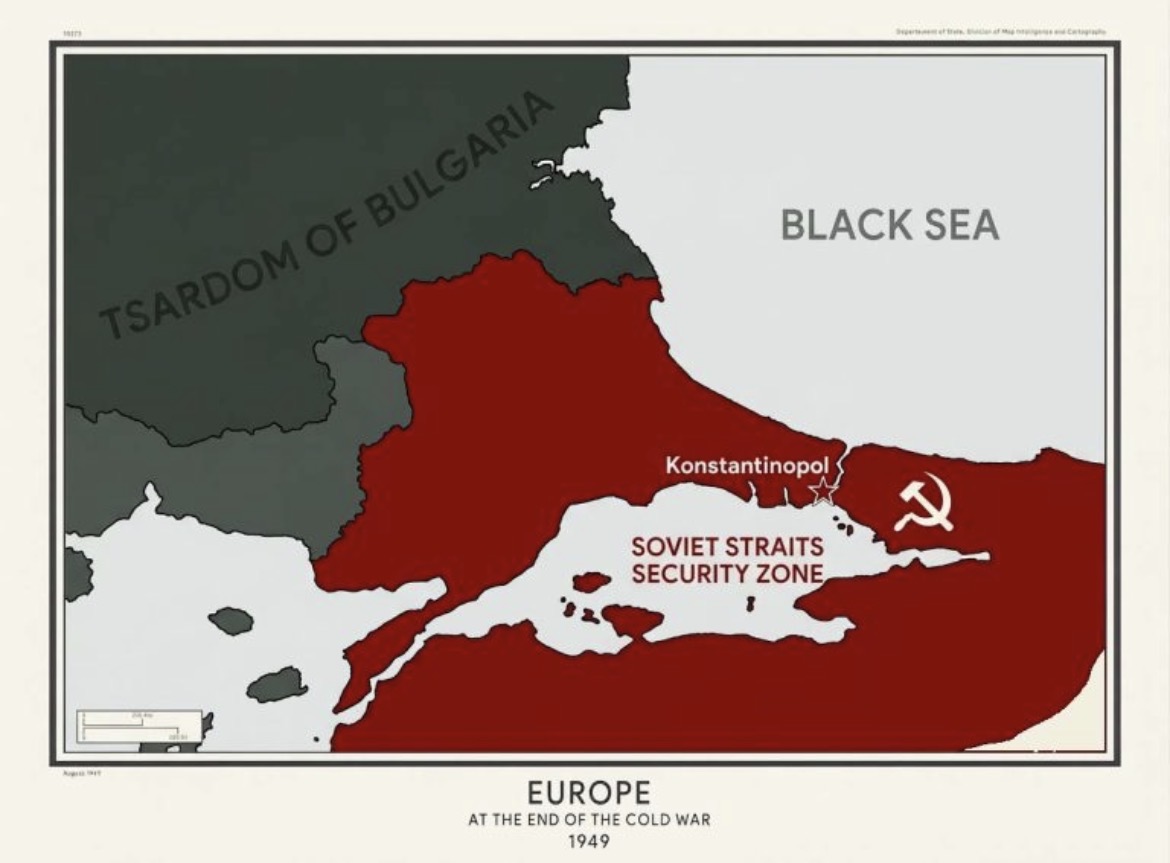
Yet the treaty itself stipulated a ten-year term. What would have happened had Berlin actually decided to honor it—at least until 1949? This is the very scenario depicted in an alternate-history map by user Ordinary-User1996, published in the AlternateHistory community. The author proposes a fascinating point of divergence: instead of the Great Patriotic War, an almost decade-long German-Soviet "Cold War" emerges, during which the two totalitarian superpowers divide Europe and build up their arsenals, fully aware that a confrontation is inevitable sooner or later.
Moreover, the consequences of this single change prove far more sweeping than simply the absence of the events of June 22, 1941.
A pact that evolved from a temporary deal into the foundation of the European order
It is worth starting with an important caveat. The Molotov-Ribbentrop Pact did not turn Nazi Germany and the Soviet Union into genuine allies. Formally, it was a non-aggression treaty supplemented by a secret protocol delineating spheres of interest in Eastern Europe. In the initial protocol, the parties defined their interests regarding Poland, Finland, Estonia, Latvia, Lithuania, and Bessarabia. Following the partition of Poland, these arrangements were refined by the Boundary and Friendship Treaty of September 28, 1939.
Therefore, for the world depicted on the map to come into existence, Hitler did not need to suddenly embrace communism, nor Stalin National Socialism. Only one thing was required: for Berlin to decide that a war with the USSR was not yet in its interest.
And there was indeed an economic basis for such coexistence to continue. In February 1940, the USSR and Germany concluded a major economic agreement. The Soviet Union was to supply Germany with oil, grain, manganese, iron ore, cotton, timber, and other raw materials, receiving German industrial equipment and technology in return. The deliveries stipulated by the agreement alone included approximately 900,000 tons of petroleum products, 200,000 tons of food grain, 800,000 tons of animal feed, 300,000 tons of manganese, and hundreds of thousands of tons of ore. In January 1941, a new agreement was concluded, aimed at further expanding trade.
In our history, all of this came to an abrupt end with the launch of Operation Barbarossa. In this alternative scenario, it becomes one of the foundations for a very strange symbiosis between the two regimes.
The Key Divergence: No "Barbarossa"
Following the defeat of France in the summer of 1940, Germany effectively faced two main adversaries: Great Britain in the west and the USSR as a potential future opponent in the east. In reality, Hitler chose the latter course, believing the Soviet Union could be destroyed in a single, short campaign.
In this alternative history scenario, he makes the opposite decision.
Plans to attack the USSR are shelved. While a significant portion of the German army remains on the eastern border as a safeguard, the bulk of resources is directed against Great Britain. There is no need to amass the vast stockpiles required for a march from Brest to Moscow, nor to redeploy millions of troops eastward or prepare dozens of divisions for a land war across the vast expanses of the USSR. The Luftwaffe can focus on Britain, the Kriegsmarine receives significantly higher priority, and the construction of submarines, landing craft, and long-range aircraft is accelerated.
The author of the original scenario posits that this is precisely what ultimately enables Germany to achieve what it failed to accomplish in reality.
"Sea Lion" Finally Makes Landfall
This is perhaps the boldest premise of the entire alternative history scenario. According to the scenario, the Battle of Britain does not end in a de facto German failure in the autumn of 1940. The air campaign drags on much longer, while Germany simultaneously prepares for an invasion far more seriously than it did in actual history.
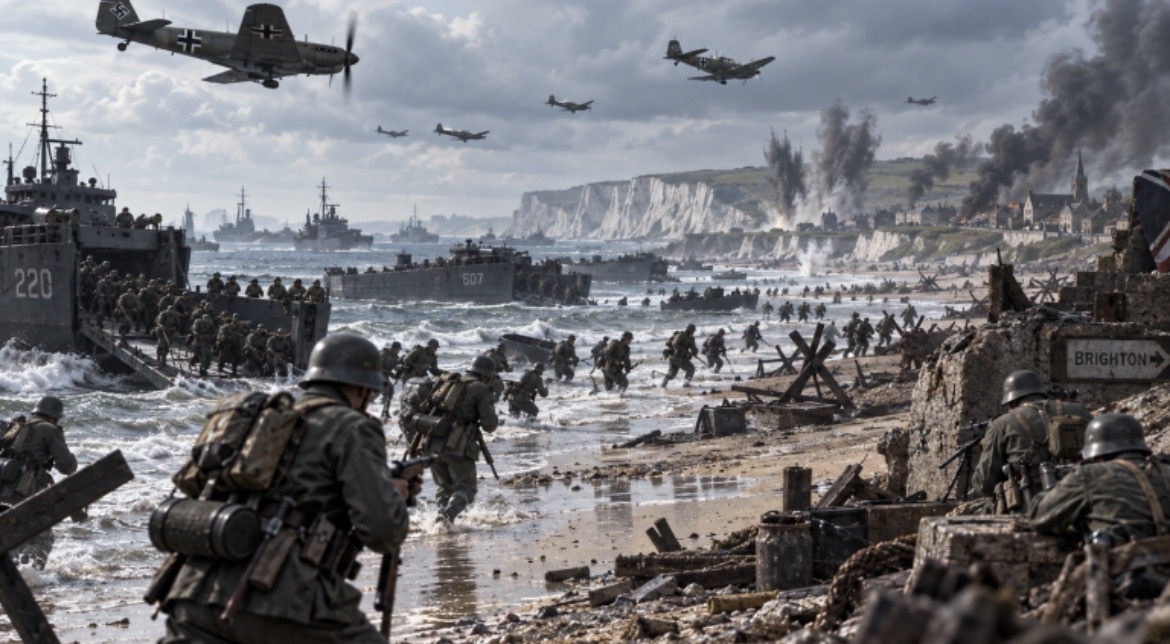
Operation Sea Lion commences in May 1941.
Even without an Eastern Front, a cross-Channel landing remains an incredibly complex operation. Germany lacks a navy capable of simply destroying the Royal Navy; furthermore, transporting and—crucially—continuously supplying a large ground force across the Channel is far more difficult than merely landing the initial waves of troops. That is precisely why, even when discussing the initial map, many readers cite a successful "Operation Sea Lion" as the most controversial part of the scenario.
However, an alternative history allows us to envision a scenario where Germany does not attempt a hasty, improvised landing in the autumn of 1940, but instead spends nearly a year methodically preparing for it. British air losses mount, ports and airfields come under constant attack, the U-boat war intensifies, and German industry directs significantly more resources toward the conflict with Great Britain.
In May 1941, the Germans finally cross the English Channel. A grueling campaign begins on the British Isles themselves. There is no quick victory, but after prolonged fighting, the British government agrees to an armistice.
And this is where the scenario becomes particularly interesting.
Hitler Does Not Destroy Great Britain
Germany does not turn the United Kingdom into yet another occupied territory, nor does it dismantle the British state. The scenario is based on the Nazi leadership's specific view of the British as a kindred "Germanic people." Consequently, Berlin demands not the country's total destruction, but its withdrawal from the war and the relinquishing of key strategic positions.
The British Empire remains intact, but its influence is drastically curtailed.
Gibraltar is ceded to Spain. Italy acquires Malta, Cyprus, and Egypt. This effectively ends British dominance in the Mediterranean, establishing Italy as the primary power in the central and eastern Mediterranean.
This simultaneously signifies the collapse of a crucial pillar of British global strategy. London remains the capital of an independent nation and a vast colonial empire, yet it can no longer dictate the European balance of power. The continent falls almost entirely under the sway of Germany and the USSR.
America Remains Outside the European War
The next major shift occurs on December 7, 1941.
Japan attacks Pearl Harbor, and the United States enters the war in the Pacific. However, in this reality, Germany does not declare war on the US.
In actual history, Hitler did so on December 11, 1941, effectively turning American involvement in the European war from a possibility into an inevitability on his own initiative. Here, Berlin acts with far greater caution. With Great Britain already out of the war and the Soviet Union maintaining neutrality, there is no sense in voluntarily adding America’s colossal industrial might to the list of enemies.
Effectively, two separate wars emerge.
The US fights Japan in the Pacific, while Germany is free to consolidate the gains of its European conquests without interference. There is no American strategic bombing campaign on the scale known from actual history. There is no Normandy landing. There are no American armies in France or Germany.
For the Third Reich, this is a nearly ideal strategic situation.
A German Europe
Throughout the 1940s, Berlin gradually transforms its military victories into a new political system for Europe. France remains defeated and dependent. Central Europe is under German control. Scandinavia, the Balkans, and various other territories form a network of dependent states, allies, and satellites of the Reich.
Even the last pockets of European neutrality are gradually disappearing. Under the author's scenario, Germany executes Operation Tannenbaum and occupies Switzerland and Liechtenstein.
Yet, the outward calm of this vast empire is deceptive.
Berlin must maintain garrisons in conquered territories, combat underground resistance, manage a complex web of alliances, and simultaneously prepare for a future war with the USSR. While the Reich's economy is spared the devastation of four years of total war in the East, it also loses a vital source of resources: the massive plunder of captured Soviet territories that Nazi plans had counted on.
Consequently, the survival of such a system until 1949 is by no means guaranteed. Even the map's creator acknowledges in the discussion that the economic viability of this version of the Third Reich is one of the most contentious aspects of the scenario.
And what is Stalin doing during this time?
For the Soviet Union, the absence of June 22, 1941, implies a completely different history.
There are no catastrophic encirclements like those of 1941. There is no loss of Belarus, Ukraine, and a significant portion of European Russia. There is no need to evacuate thousands of industrial enterprises beyond the Volga and to the Urals. Millions of soldiers and civilians do not perish. Leningrad is not besieged, Stalingrad is not reduced to ruins, and vast swathes of the USSR’s western regions do not suffer occupation and destruction.
Instead, industrialization continues virtually uninterrupted.
The armed forces gain invaluable time. Shortcomings identified during the Soviet-Finnish War are gradually rectified. Production of T-34 and KV tanks ramps up without the need to operate under evacuation conditions. The aviation industry masters a new generation of aircraft. Artillery, communications, and motor transport are improved.
And above all, the Soviet Union does not lose its immense human potential.
This gives rise to a paradox. By postponing the attack, Hitler gains the opportunity to defeat Great Britain and build his continental empire, yet simultaneously allows his future primary adversary to grow stronger with each passing year.
Stalin turns his attention to the Bosphorus.
With a secure western border, Moscow begins to expand its sphere of influence. The Baltic states have already been incorporated into the USSR and Bessarabia occupied; the Black Sea becomes the next natural direction for expansion.
Here, the map's creator employs an idea rooted in genuine history.
The Soviet leadership did indeed show keen interest in the regime governing the Black Sea straits. In actual history, following World War II, Moscow demanded a revision of the Montreux Convention and sought to establish Soviet bases in the vicinity of the straits. In 1945, the Soviet side officially proposed establishing a new regime for the Bosphorus and Dardanelles involving both the USSR and Turkey, which would include provisions for Soviet military bases.
In this alternate reality, the conflict begins earlier and escalates far more severely.
The USSR goes to war with Turkey. Germany, despite its ideological hostility toward communism, does not intervene: the pact remains in force, and Berlin has no direct interest in saving Turkey at the cost of a war with the Soviet Union.
As a result, Moscow achieves a centuries-old geopolitical dream: access to the Straits.
The Soviet Straits Zone
Following Turkey's defeat, a Soviet security zone for the Straits is established in the Bosphorus region. On the author's map, this zone encompasses Constantinople—Istanbul—and grants the USSR direct military control over the outlet from the Black Sea.
For Moscow, this represents a massive strategic gain.
The Black Sea Fleet is no longer geographically trapped. Soviet ships gain guaranteed access to the Mediterranean, and the USSR itself transforms from a purely continental power into a full-fledged Mediterranean power.
Admittedly, the name "Constantinople" appears to be more of an artistic flourish on the map; for the Soviet state, reviving the city's imperial Greek name would have been ideologically incongruous. Readers commenting on the original post rightly pointed this out. Yet, the very idea of a Soviet military presence in the Straits is historically far less far-fetched than it might seem.
Thus, by the mid-1940s, a vast Soviet sphere emerges, stretching from the Baltic to the Black Sea and the Bosphorus.
Two Predators on Opposite Sides of the Border
It is precisely at this moment that the term "German-Soviet Cold War" begins to fully reflect the reality of the situation.
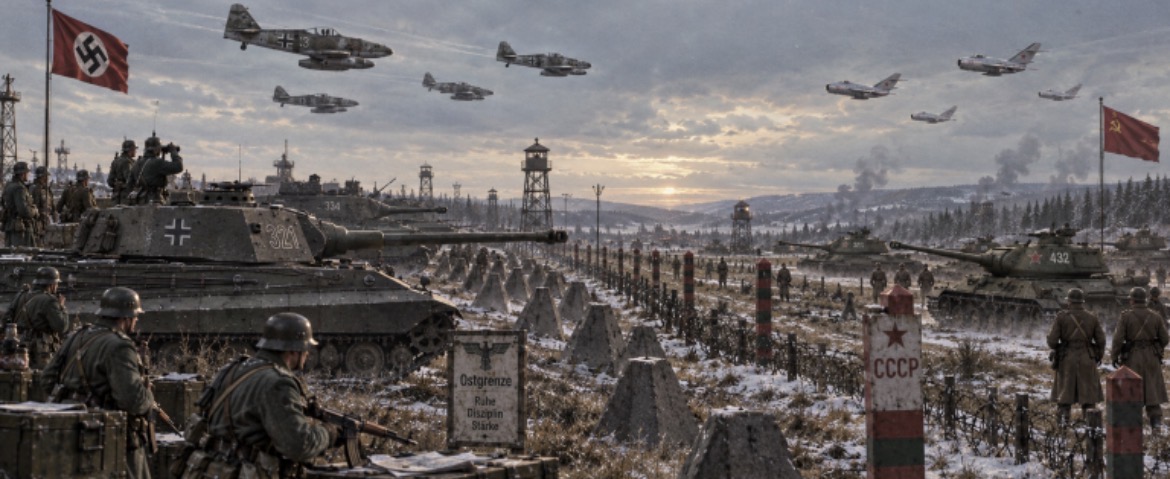
On the map, Europe appears relatively calm. There is no major war. Trains cross the German-Soviet border. Trade continues. Diplomats meet. Formally, Berlin and Moscow are honoring their signed agreements.
Yet, both sides are preparing to kill one another.
Germany is building a new army for a future campaign in the East. Generalplan Ost has not vanished; Nazi ideology itself renders long-term peaceful coexistence with the USSR virtually impossible. The project’s implementation has merely been postponed.
The Soviet leadership is fully aware of this as well. Across the border lies a state whose official ideology views the eastern lands as future "living space" (Lebensraum).
Consequently, the border is gradually transforming into one of the most militarized lines on the planet.
A peculiar kind of Cold War is emerging—one without NATO or the Warsaw Pact. Instead of the USA and the USSR, it is Germany and the Soviet Union that stand in opposition.
An Arms Race Unlike Anything the World Had Ever Seen
It is here that the consequences of a decade of peace become particularly alarming.
In actual history, Germany went to war against the USSR with large numbers of Pz.Kpfw. III and Pz.Kpfw. IV tanks, while the Panthers, Tigers, Me 262 jets, V-2 ballistic missiles, and many other advanced systems appeared only during the course of the conflict.
Similarly, in 1941, the USSR was just beginning the mass production and deployment of the T-34, KV, Yak-1, MiG-3, and Il-2, as well as new artillery systems.
Now, let us imagine that both countries are granted another eight years.
And not eight years of destructive war—consuming people, machine tools, fuel, and factories—but eight years of an arms race. By 1949, the Red Army could have possessed a vast number of next-generation tanks, developed based on the experience gained with the T-34 and heavy armor. Germany—having not lost millions of troops on the Eastern Front nor endured such devastating Anglo-American bombing raids—could likewise have advanced its jet aviation, guided weaponry, and missile technology to a far higher level.
End of part one.